
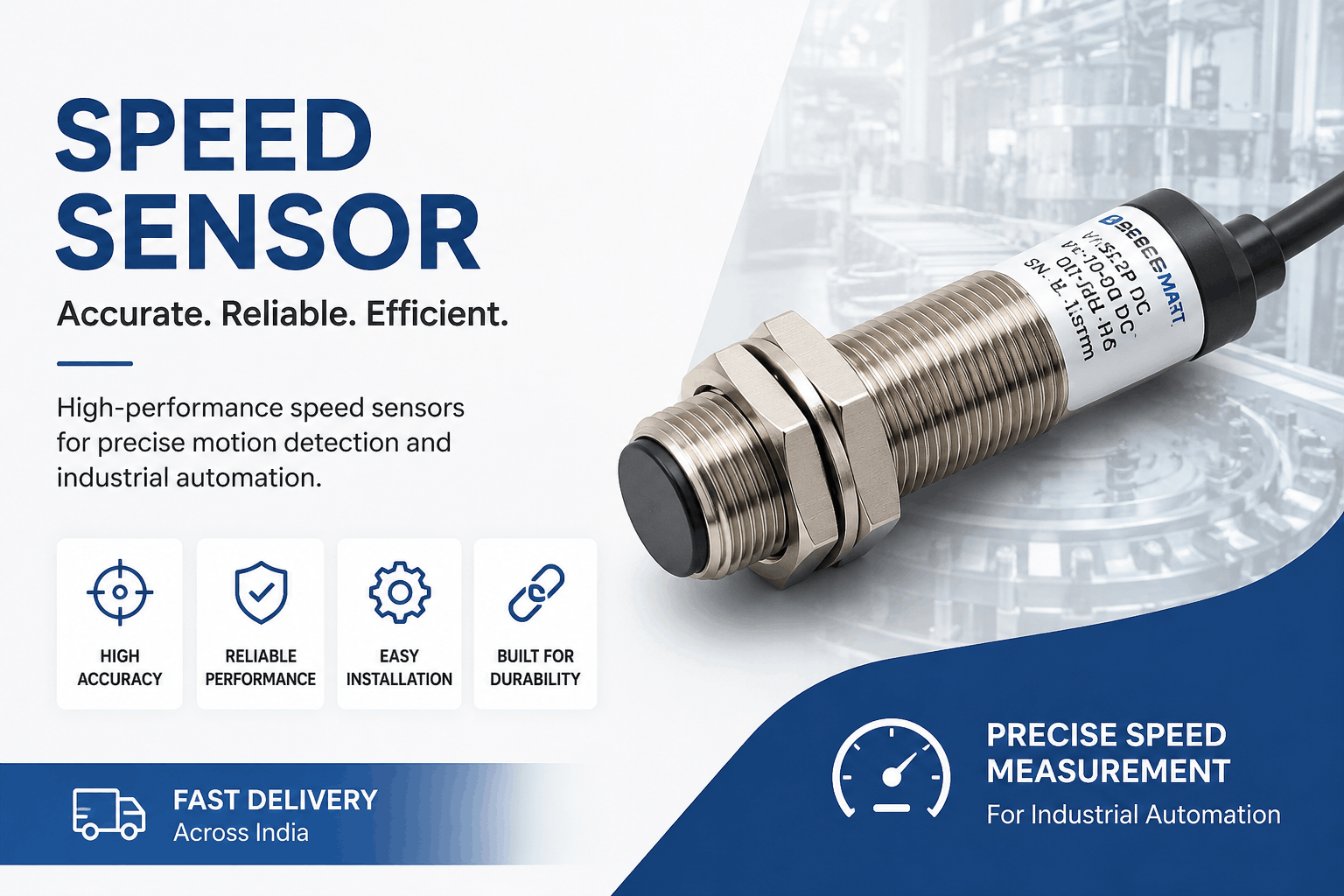
In modern machinery, automotive engineering, and industrial automation, accurate velocity measurement is essential for safety, efficiency, and real-time control. A Speed Sensor is a crucial electronic transducer that detects rotational or linear velocity and converts physical motion into readable electrical signals. From anti-lock braking systems (ABS) in automobiles to conveyor belts in automated factories, every modern Speed Sensor provides vital data that prevents equipment wear, optimizes power consumption, and ensures process precision.
At SensorMart, we offer high-grade electronic components, motion transducers, and industrial modules designed for demanding operational environments. Whether you are building an automotive project, monitoring industrial motors, or designing robotic systems, selecting the right Speed Sensor guarantees optimal system performance.
This guide explores what a Speed Sensor is, its core components, working mechanisms, primary types, real-world applications, and why sourcing top-quality motion monitoring components from SensorMart makes a critical difference. more blogs
What is a Speed Sensor?
A Speed Sensor is an analytical device engineered to measure the rate of change in position of an object relative to time. It detects rotational speed (measured in RPM), linear velocity, or angular movement and transmits electrical pulses or analog signals to a central control unit, such as an Electronic Control Unit (ECU) or a Programmable Logic Controller (PLC).
Unlike simple proximity switches, a modern Speed Sensor tracks continuous dynamic frequency shifts. As a target shaft, gear tooth, or magnet rotates past the sensing face, the Speed Sensor generates proportional electrical pulses. The faster the target rotates, the higher the pulse frequency, allowing connected computers to calculate instantaneous velocity accurately.
Engineering teams turn to SensorMart for high-accuracy Speed Sensor components that maintain reliable signal integrity across wide temperature ranges and high-vibration conditions.
Core Components of a Speed Sensor
To convert physical motion into digital data efficiently, a high-performance Speed Sensor relies on three essential elements:
- Target or Trigger Wheel: A moving object—such as a ferromagnetic gear, slotted disc, or magnetic ring—that interacts with the Speed Sensor face.
- Sensing Element: The core transducer component (Hall IC, inductive coil, magnetoresistive element, or photodetector) that detects variations in magnetic flux, light disruption, or impedance as the target moves.
- Signal Conditioning Electronics: Internal circuitry that amplifies, filters, and transforms raw physical variations into standardized digital square waves, frequency outputs, or voltage signals.
By sourcing custom Speed Sensor modules from SensorMart, developers ensure low electronic noise, fast response times, and maximum protection against electromagnetic interference (EMI).
How Does a Speed Sensor Work?
The operational mechanism of a Speed Sensor follows a clear step-by-step sequence:
[ Rotating Target ] ---> [ Magnetic/Light Variation ] ---> [ Sensing Element ]
                                                                  |
                                                                  v
[ Control Unit / Display ] <--- [ Digital/Analog Output ] <--- [ Signal Conditioner ]
- Motion Detection: As a toothed gear or rotating shaft spins, its individual teeth or magnetic poles pass directly across the sensing face of the Speed Sensor.
- Field Perturbation: The passing target causes a disturbance in the surrounding magnetic field or interrupts a light beam within the Speed Sensor assembly.
- Signal Generation: This disturbance causes the internal transducer of the Speed Sensor to generate alternating voltage pulses or resistance changes.
- Pulse Processing: Integrated electronics inside the Speed Sensor clean up these signals, converting raw sine waves into crisp, square-wave pulses.
- Velocity Calculation: The host microcontroller measures the pulse frequency over time to compute exact rotational or linear speed.
Major Types of Speed Sensors
Depending on the underlying physics and environmental requirements, a Speed Sensor can be categorized into several primary types:
| Speed Sensor Type | Sensing Mechanism | Key Characteristics | Ideal Applications |
| Hall Effect Speed Sensor | Active magnetic sensing via semiconductor ICs | Reads down to zero RPM; outputs clean digital square waves | Automotive ABS, wheel speed, transmission control |
| Inductive Speed Sensor | Passive electromagnetic induction via coil and magnet | Self-powered; highly durable; less accurate at near-zero RPM | Crankshaft timing, heavy industrial motors |
| Optical Speed Sensor | Infrared or laser light reflection/interruption | Extremely high accuracy and resolution; sensitive to dust | Robotics, laboratory equipment, printers |
| Magnetoresistive Speed Sensor | Resistance changes in thin-film materials | Superior sensitivity to small magnetic flux variations | High-precision shaft position and direction sensing |
| Radar Speed Sensor | RF radio waves using the Doppler effect | Non-contact long-range measurement; weather-resistant | Traffic control, railway systems, agricultural vehicles |
Hall Effect Speed Sensor
The Hall effect Speed Sensor is among the most versatile options available. Because it uses an active semiconductor element, a Hall effect Speed Sensor can accurately measure static or zero-speed conditions, making it vital for modern vehicle safety modules. SensorMart provides top-tier Hall effect Speed Sensor modules for various industrial setups.
Inductive Speed Sensor
An inductive Speed Sensor operates without external power by producing a small AC voltage through electromagnetic induction as target teeth pass by. It excels in rugged environments contaminated by dust, oil, or high temperatures.
Optical Speed Sensor
An optical Speed Sensor uses a light transmitter and photodetector targeting an encoder disc. This design delivers exceptional signal precision, ideal for clean laboratory and robotic settings.
Critical Features of an Ideal Speed Sensor
When specifying a Speed Sensor for industrial or automotive deployment, engineers look for key performance attributes:
- Zero-Speed Capability: The ability of a Speed Sensor to accurately detect motion even when the shaft is moving at near-zero velocity.
- Environmental Sealing: Protection ratings (such as IP67 or IP68) that shield the internal Speed Sensor elements from moisture, dust, and corrosive chemicals.
- Wide Operating Temperature: Thermal endurance allowing the Speed Sensor to operate reliably near hot vehicle engines or industrial furnaces.
- High Frequency Response: The capacity of a Speed Sensor to process high-frequency signals from high-RPM machinery without pulse dropping.
At SensorMart, every Speed Sensor housing and component is vetted against strict industrial quality benchmarks.
Key Applications of Speed Sensor Technology
The adaptability of the Speed Sensor makes it vital across numerous global industries:
1. Automotive Safety and Drivetrain Control
Vehicles depend on a wheel Speed Sensor array for Anti-lock Braking Systems (ABS), Electronic Stability Control (ESC), and traction management. Additionally, transmission systems use a specialized Speed Sensor to regulate automatic gear shifts smoothly.
2. Industrial Machinery and Automation
In automated manufacturing, a Speed Sensor monitors conveyor belt velocity, motor shaft rotation, and turbine performance. Immediate feedback from a Speed Sensor prevents motor overspeed conditions, belt slippage, and costly mechanical jamming.
3. Energy Generation and Utilities
Wind turbines use a rugged Speed Sensor to track generator rotor speed and trigger blade pitch adjustments during high-wind conditions. Power generation plants rely on magnetic Speed Sensor probes for real-time turbine condition monitoring.
4. Transportation and Heavy Mobile Equipment
Off-highway equipment, fork-lifts, agricultural tractors, and railway locomotives use heavy-duty Speed Sensor designs for speedometers, engine governor controls, and navigational tracking.
Why Choose Speed Sensor Hardware from SensorMart?
Selecting the right sensing components directly impacts overall system reliability and machine safety. SensorMart is a premier distributor and component provider offering dependable, high-precision motion detection hardware.
- Comprehensive Inventory: From discrete Hall effect ICs to industrial heavy-duty Speed Sensor probes, SensorMart supplies components for every application.
- Calibrated Precision: Every Speed Sensor offering at SensorMart undergoes quality assurance to ensure accurate frequency translation and low operational drift.
- Technical Expertise: The engineering team at SensorMart provides guidance on sensor selection, target alignment, and signal conditioning integration.
Conclusion
The modern Speed Sensor remains a critical component in smart transportation, power generation, and industrial automation. By translating mechanical movement into precise digital signals, these devices enable reliable control and prevent equipment failure. Partnering with SensorMart ensures access to durable, high-precision Speed Sensor hardware tailored to meet your technical requirements.peed sensors also help monitor: conveyor systems, vehicle traffic, and more. Businesses that select high-quality speed sensors will experience improved productivity and reduced downtime. wikipedia
FAQs
1. What is a speed sensor used for?
A speed sensor is used to measure the speed of rotating or moving equipment in industrial and automotive systems.
2. What are the main types of speed sensors?
Common types include Hall effect sensors, inductive sensors, optical sensors, and magnetic speed sensors.
3. Where are speed sensors commonly used?
They are used in vehicles, factories, robotics, turbines, and automation systems.
4. Why are speed sensors important in automation?
They provide accurate speed data for process control, safety, and machine efficiency.
5. Does Sensor Mart provide industrial speed sensors?
Yes, Sensor Mart offers high-quality industrial speed sensors for different applications.
6. Can speed sensors work in harsh industrial environments?
Yes, many industrial speed sensors are designed to resist dust, heat, vibration, and moisture.




Leave a Reply