
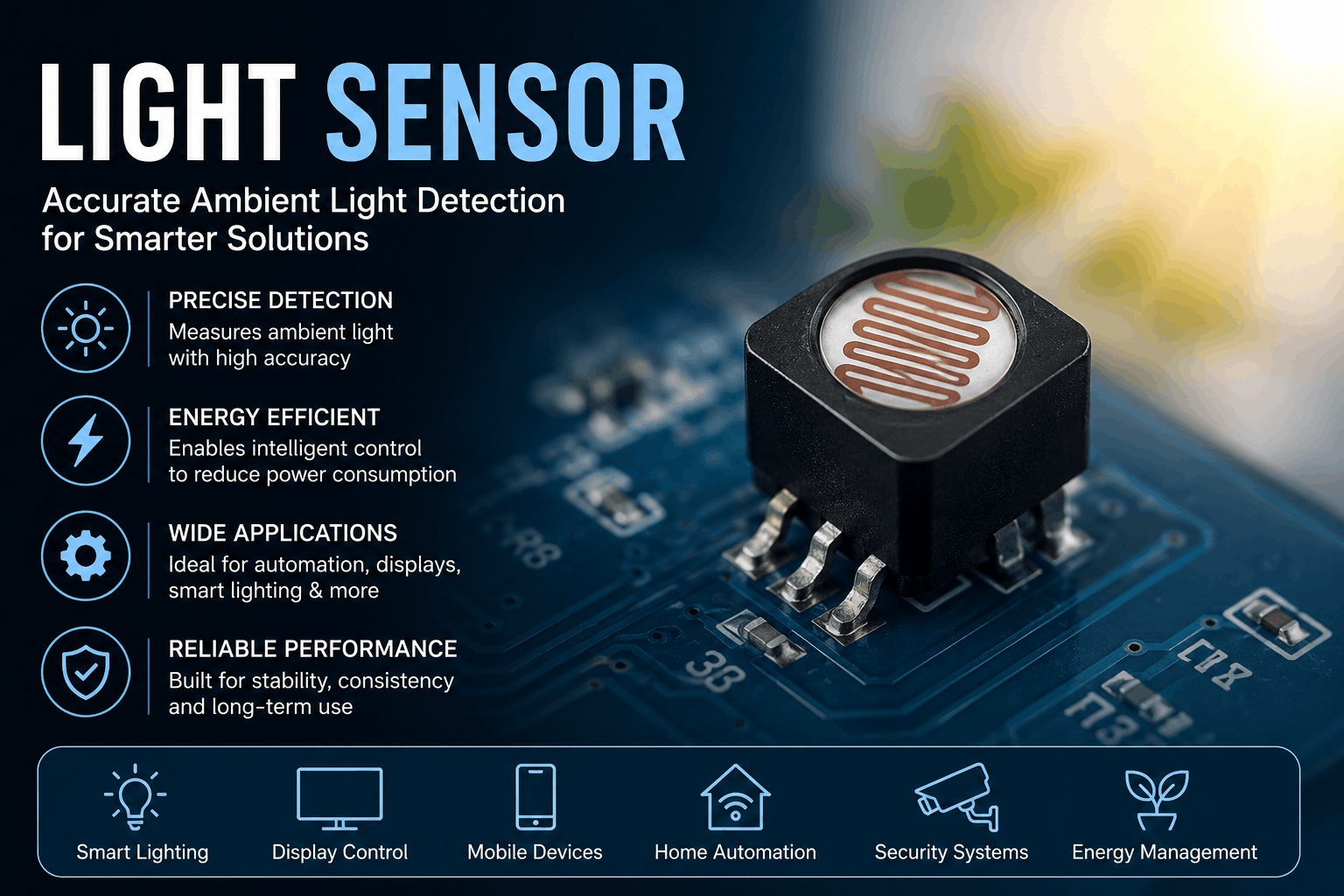
Automation & Energy Efficiency are changing how homes, commercial properties, farms, and industrial buildings operate. One type of device that aids in the process of automating through energy-efficient systems would be the Light Sensor. The use of light sensors are prevalent in all types of applications ranging from public street lights to the manufacture of smart phone devices. At Sensor Mart we offer a wide variety of high-quality light sensors.
ality light sensors designed for accurate performance, long life, and industrial-grade reliability.
What is a Light Sensor?
A Light Sensor is an electronic device that detects the presence, intensity, or absence of light. It converts light energy into an electrical signal that can be used for monitoring, automation, and control systems.
Light sensors are commonly used in:
- Automatic lighting systems
- Smartphones
- Smart homes
- Weather monitoring systems
- Industrial automation
- Agriculture monitoring
These sensors help reduce energy consumption and improve automation efficiency.
How Does a Light Sensor Work?
Light sensors operate by measuring levels of illumination and generating corresponding electrical signals. When light hits the sensor’s surface, its internal electrical characteristics change. The attached device detects these variations and executes corresponding actions based on those electrical changes.For example:
- Turning ON street lights automatically at night
- Adjusting smartphone screen brightness
- Activating security systems
- Monitoring sunlight in agriculture
The sensor continuously measures surrounding light levels and sends signals accordingly.
Types of Light Sensors
Different types of light sensors are available for different applications.
1. LDR (Light Dependent Resistor)
LDR is one of the most common light sensors. Its resistance changes according to light intensity.
Features:
- Low cost
- Simple design
- Easy installation
- Commonly used in automatic lighting
Applications:
- Street lights
- Garden lights
- Home automation
2. Photodiode
A photodiode converts light into electrical current.
Features:
- Fast response time
- High sensitivity
- Accurate light detection
Applications:
- Optical communication
- Medical devices
- Industrial equipment
3. Phototransistor
Phototransistors are more sensitive than photodiodes and provide signal amplification.
Features:
- Better sensitivity
- Reliable output
- Suitable for automation systems
Applications:
- Object detection
- Safety systems
- Counting machines
4. Infrared Light Sensor
Infrared sensors detect infrared light instead of visible light.
Features:
- Detects heat and movement
- Works in dark environments
Applications:
- Motion detection
- Security systems
- Automatic doors
5. Ambient Light Sensor
Ambient light sensors measure surrounding light levels and adjust devices automatically.
Applications:
- Smartphones
- Tablets
- Smart TVs
- Display systems
Applications of Light Sensors
Light sensors are widely used across many industries because they improve automation and save energy.
Smart Lighting Systems
Automatic street lights and smart home lighting systems use light sensors to turn lights ON and OFF based on daylight conditions.
Smartphones and Electronics
Modern smartphones use ambient light sensors to adjust screen brightness automatically.
Industrial Automation
Industries use light sensors in:
- Conveyor systems
- Object counting
- Machine automation
- Safety systems
Agriculture
Farmers use light sensors to monitor sunlight exposure for better crop growth and greenhouse automation.
Security Systems
Light sensors are used in:
- Motion detection
- Alarm systems
- Automatic security lighting
Weather Monitoring
Environmental monitoring systems use light sensors for solar radiation and sunlight measurement.
Benefits of Using Light Sensors
Energy Saving
Light sensors automatically control lighting systems and reduce electricity usage.
Improved Automation
They help create smart and automated systems.
Better Device Performance
Electronic devices can adjust brightness and power consumption automatically.
Increased Safety
Light sensors improve safety in industries and security systems.
Low Maintenance
Modern light sensors are durable and require minimal maintenance.
Important Features to Consider Before Buying a Light Sensor
When selecting a light sensor, it is important to check the following factors:
Sensitivity
Higher sensitivity provides better light detection accuracy.
Response Time
Fast response sensors react quickly to changing light conditions.
Output Type
Common output options include:
Analog output
Digital output
Voltage output
Current output
Operating Range
Choose a sensor suitable for your environmental conditions.
Build Quality
Industrial applications require weatherproof and durable sensors.
Why Light Sensors Are Important in Smart Cities
Smart cities depend heavily on automation and energy management. Light sensors play a major role in:
- Smart street lighting
- Traffic systems
- Public safety
- Smart buildings
- Energy-efficient infrastructure
Automatic lighting systems help reduce power consumption and maintenance costs.
Light Sensors in Smart Agriculture
Agriculture technology is growing rapidly, and light sensors are helping farmers improve productivity.
Applications include:
- Greenhouse monitoring
- Crop light management
- Smart irrigation systems
- Environmental monitoring
Proper sunlight monitoring helps improve plant growth and crop quality.
Industrial Use of Light Sensors
Industries use light sensors for various automation and safety tasks.
Common industrial applications:
- Packaging machines
- Production line automation
- Object detection
- Quality inspection
- Position sensing
Light sensors improve production efficiency and reduce manual work.
Maintenance Tips for Light Sensors
To ensure long-term performance:
- Keep the sensor surface clean
- Protect from dust and moisture
- Check electrical connections regularly
- Avoid physical damage
- Perform routine calibration if needed
Proper maintenance improves sensor accuracy and lifespan.
Why Choose Sensor Mart for Light Sensors?
Sensor Mart offers reliable and high-quality light sensors for industrial, commercial, and automation applications.
Benefits of choosing Sensor Mart:
- High-performance sensors
- Industrial-grade quality
- Affordable pricing
- Technical support
- Wide product range
- Fast delivery across India
Sensor Mart provides sensors suitable for smart automation, weather monitoring, industrial systems, and IoT projects.
Conclusion
Many of the most common everyday technologies can be classified as light-sensitive devices. Light sensors can play an important role in providing energy efficiency, automating tasks, enhancing security, and improving the overall efficiency of devices used throughout several industries.
Light sensors have been integrated into many different types of products, including lighting control systems, consumer electronics (including smartphones), industrial automation, and agriculture. It is increasingly becoming clear how critical light sensors will be in helping to run our daily lives and businesses.
Factors to consider when choosing a light sensor include: application type, sensitivity required, environmental conditions, and output type. Quality manufacturers of sensors ensure that their products will provide better performance, last longer, and yield more accurate results.
If you require a high-quality or industrial-grade light sensor, contact Sensor Mart for excellent solutions to a variety of applications in India.
FAQs About Light Sensors
1. What is the main use of a light sensor?
A light sensor detects light intensity and helps automate lighting and electronic systems.
2. Where are light sensors commonly used?
They are used in smartphones, street lights, industries, agriculture, and security systems.
3. What is the difference between an LDR and a photodiode?
An LDR changes resistance with light intensity, while a photodiode converts light into electrical current.
4. Are light sensors energy efficient?
Yes, light sensors help reduce electricity consumption through automatic control systems.
5. Can light sensors work outdoors?
Yes, many industrial-grade light sensors are designed for outdoor environments.
6. Which industries use light sensors the most?
Industries like automation, agriculture, electronics, security, and weather monitoring widely use light sensors.



Leave a Reply