
Introduction
In the fields of agriculture equipment, wind power energy, air transportation and aeronautics, environmental monitoring, etc., aerodynamic and meteorological measurements are of great importance. The traditional way of measuring wind is by using moving mechanisms that can wear out over time and need periodic maintenance of Ultrasonic Wind Sensor. more blogs
The Ultrasonic Wind Sensor is a more updated and reliable solution.
The purpose of this guide is to show the workings, benefits and uses of ultrasonic wind sensors. The professional wind sensor users in the world have increasingly selected ultrasonic wind sensors.
Sensormart manufactures cutting edge ultrasonic wind sensors for accurate, real-time wind sensing in a wide range of challenging applications.
What is an Ultrasonic Wind Sensor?
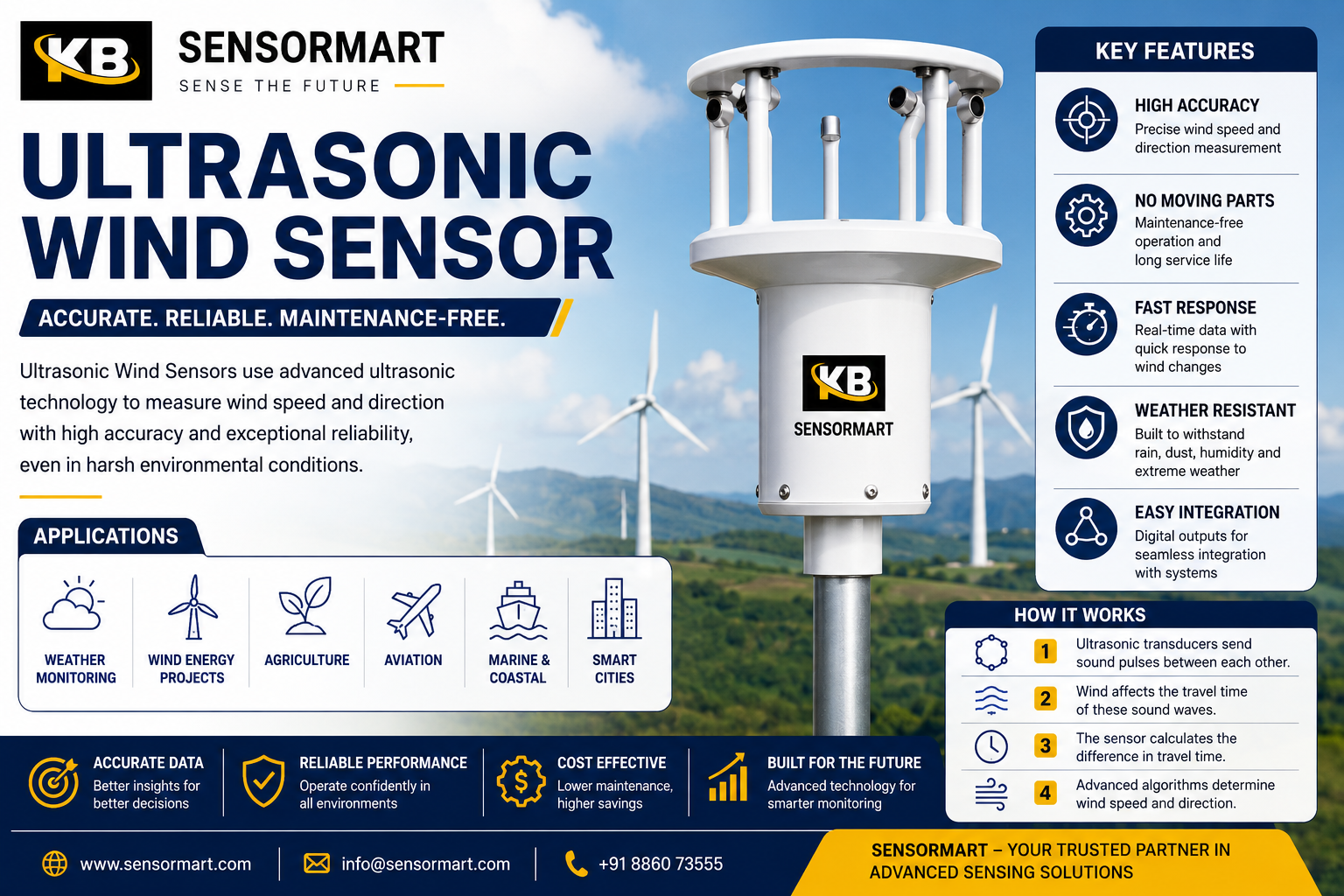
The Ultrasonic Wind Sensor is a complex device used for measuring wind direction and wind speed with the use of ultrasonic sound waves. Compared with the traditional cup or vane wind instruments, ultrasonic wind sensors have no mechanical moving parts, thus are extremely durable, accurate and maintenance free.
During the operation of the sensor, the ultrasonic wave pulses are sent from one transducer to another. The sensor is able to measure wind speed and direction accurately by measuring the time it takes for the ultrasonic signal between the two transducers to pass through.
How Does an Ultrasonic Wind Sensor Work?
The working principle of Ultrasonic Wind Sensor:
The working principle of an ultrasonic wind sensor is based on the effect of the wind on the propagation of sound.
In order to do this, ultrasonic transducers are used to send and receive audio signals back and forth between the transducers. The sensor then determines the amount of time it takes for the sound waves to get from one transducer to the other. The wind then has an effect on the speed that those audio signals travel between the transducers. The sensor is then able to measure the wind speed and direction with the help of advanced algorithms because of these differences in travel time.
The sensor transmits the results in real-time to the monitoring systems. This technology provides for a high level of accuracy in measuring wind, even in severe environmental conditions.
Key Features of Ultrasonic Wind Sensors
1. No Moving Parts
The ultrasonic wind sensors are made of non-rotating parts and have a longer service life due to the negligible wear and tear.
2. High Accuracy
The wind speed and direction that these sensors can measure are very accurate and are therefore appropriate for critical applications.
3. Fast Response Time
Wind change detection can be done in real time with ultrasonic technology.
4. Low Maintenance
There is minimal need for mechanical parts, which decreases maintenance needs and operational expenses.
5. Weather Resistance
With the development of modern ultrasonic wind sensors, they can be operated reliably under extreme conditions such as rain, dust, humidity and high temperature environment.
6. Digital Output Integration
They can be readily deployed with weather stations, IoT systems, SCADA platforms and industrial monitoring networks.
Benefits of Using Ultrasonic Wind Sensors
Superior Reliability
Traditional mechanical sensors may fail due to friction, corrosion, or mechanical damage. Ultrasonic sensors eliminate these issues and deliver consistent performance.
Long-Term Cost Savings
Although the initial investment may be higher, reduced maintenance and longer operational life lead to significant cost savings over time.
Enhanced Data Quality
Precise wind data helps organizations make informed decisions in weather forecasting, renewable energy management, and environmental monitoring.
Improved Operational Efficiency
Real-time wind measurements allow industries to optimize operations and improve safety standards.
Applications of Ultrasonic Wind Sensors
Weather Monitoring Stations
Meteorological departments rely on ultrasonic wind sensors to collect accurate atmospheric data for weather forecasting and climate research.
Wind Energy Projects
Wind farms use ultrasonic wind sensors to assess site conditions, monitor turbine performance, and maximize energy production.
Smart Cities
As cities become smarter and more connected, ultrasonic wind sensors support environmental monitoring systems, air quality management, and urban planning initiatives.
Agriculture
Farmers use wind data for irrigation planning, pesticide spraying, and crop management, improving productivity and resource efficiency.
Aviation
Airports require accurate wind information for safe aircraft takeoff and landing operations.
Marine and Offshore Applications
Ships, ports, and offshore platforms depend on reliable wind measurements for navigation, safety, and operational planning.
Why Choose Sensormart Ultrasonic Wind Sensors?
When selecting a wind monitoring solution, reliability and accuracy are essential. Sensormart offers premium-quality ultrasonic wind sensors designed to meet industry requirements across multiple sectors.
Advantages of Sensormart:
- Wind speed/direction: very accurate.
- Strong – will last a long time and weather
- Will require no maintenance, but will need to be replaced.
- Simple to connect with monitoring systems
- Applicable to industrial, environmental and smart city systems and applications.
- Get good technical support and product knowledge
- With its quality and innovative approach, Sensormart can offer businesses a reliable method for wind monitoring performance.
Factors to Consider Before Buying an Ultrasonic Wind Sensor
When buying an ultrasonic wind sensor, consider: measurement accuracy requirements; environmental operating conditions; communication protocols and outputs; power consumption; installation location; compatibility/ability to integrate with existing systems; long-term maintenance requirements. Therefore, to ensure the optimal performance and maximum return on investment of your new sensor, it is best to select the correct one.
Conclusion
Thanks to ultrasonic wind sensors, how industries measure and monitor the conditions of the wind has changed. They are excellent alternative for environmental monitoring in this modern age because of their design, which is maintenance free, highly accurate, fast acting and long lasting. see more
Sensormart has an incredibly wide selection of ultrasonic wind sensor options available for weather stations, wind farms, smart cities, agricultural industries as well as industrial facilities. Saving time, money and lives by investing in the sophisticated wind sensing technologies will be a game-changer when it comes to improving operational efficiency, safety and future decision making. see more
Frequently Asked Questions (FAQs)
1) Where would an ultrasonic wind sensor be applied?
The applications range from meteorological collecting sites to meteorological stations used to track incoming storms to wind energy development to agricultural data collection to aviation to smart cities.
2) Is an ultrasonic wind sensor accurate?
The use of an ultrasonic wind sensor has proven to be more accurate than the old mechanical style desig!
3) Do ultrasonic wind sensors require maintenance?
Because there are no moving parts that could wear out over time, the amount of maintenance required is almost nonexistent.
4) Will ultrasonic wind sensors work well in extreme weather conditions?
Most ultrasonic wind sensors are designed to work well in rain, dust, humidity, and extreme temperature conditions, while still providing reliable measurements.
5) How do ultrasonic wind sensors compare to traditional anemometers?
Ultrasonic wind sensors provide better accuracy, faster response times, longer life expectancy, lower maintenance costs, and greater reliability than traditional anemometers.
6) Where can I find a good ultrasonic wind sensor in India?
Sensormart is a trusted source of sensors and will have ultrasonic wind sensors as part of their extensive selection of sensors for industrial and environmental monitoring applications in India.



Leave a Reply