
Introduction
In today’s hyper-connected, tech-driven world, precise motion tracking and orientation are critical. From keeping your smartphone screen oriented correctly when you tilt it to stabilizing advanced drones mid-flight, motion detection technologies play an indispensable role behind the scenes. At the core of this seamless spatial awareness is a powerful electronic component: the gyro sensor.
Whether you are designing next-generation robotics, building consumer electronics, or optimizing industrial automation systems, understanding how a gyro sensor operates, its distinct variants, and its key technical parameters is vital. In this detailed guide, sensormart explores everything you need to know about gyro sensors, their real-world applications, and how to select the right device for your precise application. more blogs
What is a Gyro Sensor?
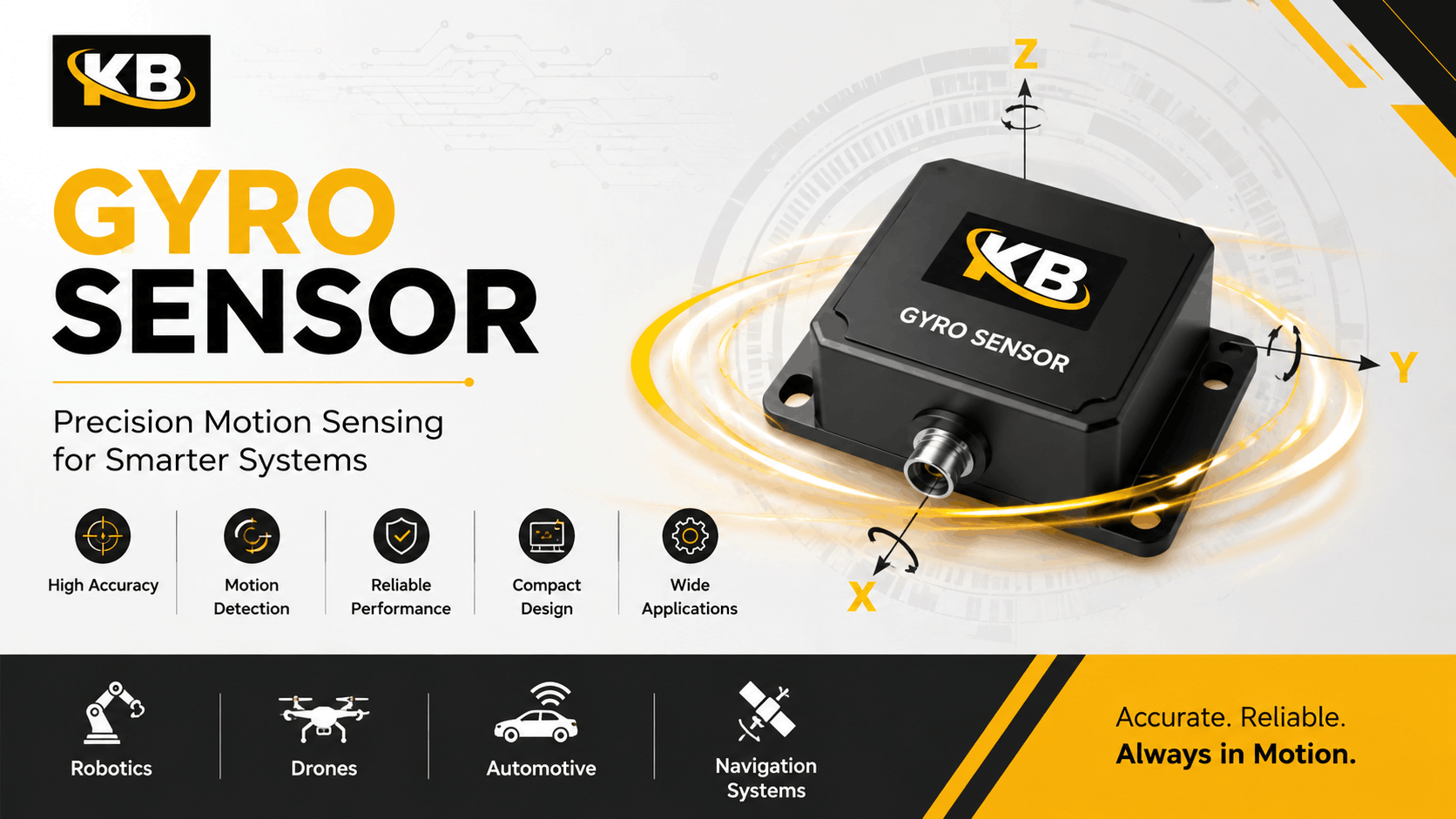
A gyro sensor (short for gyroscope sensor) is an electronic device designed to measure or maintain angular velocity and rotational orientation. Angular velocity refers to the speed at which an object rotates around a specific axis, typically measured in degrees per second (°/s) or revolutions per minute (RPM).
While basic accelerometers detect linear motion and gravity vector orientation, a dedicated gyro sensor isolates and measures dynamic rotation. By sensing precise changes in orientation across three spatial dimensions—pitch, roll, and yaw—the gyro sensor provides accurate spatial positioning data that modern microcontrollers and signal processing units require to stabilize, navigate, and control complex systems. At sensormart, we offer a comprehensive portfolio of motion detection components tailored for both consumer applications and heavy-duty industrial tasks.
How Does a Gyro Sensor Work?
To understand how a gyro sensor functions, it helps to distinguish between mechanical classical gyroscopes and modern electronic versions.
The Physics Behind the Gyro Sensor
Traditional mechanical gyroscopes rely on a fast-spinning rotor mounted inside gimbal rings. Thanks to the conservation of angular momentum, the spinning wheel resists external changes to its orientation, keeping its balance regardless of how the outer frame tilts.
However, modern electronic systems require miniature components without bulky spinning wheels. Modern electronic equipment uses Micro-Electro-Mechanical Systems (MEMS) technology. A MEMS-based gyro sensor utilizes the Coriolis Effect to detect rotational movement:
- Internal Vibrating Elements: Inside a MEMS gyro sensor, tiny silicon proof masses continuously vibrate at high frequencies.
- Coriolis Force Induction: When the target device experiences rotational motion along a specific axis, a physical force known as the Coriolis force acts on the vibrating proof mass perpendicular to its motion vector.
- Capacitive Shift: The resulting displacement causes small variations in electrical capacitance between internal micro-plates.
- Signal Processing: The internal ASIC (Application-Specific Integrated Circuit) inside the gyro sensor measures these capacitive changes, translates them into voltage outputs, and transmits clean digital angular rate measurements to the host controller.
Through this elegant mechanical-to-electrical transformation, a tiny MEMS gyro sensor can instantly deliver exact angular speed values to external systems.
Types of Gyro Sensors
Different engineering applications demand distinct levels of measurement accuracy, dynamic response, and physical durability. sensormart stocks and supplies multiple specialized varieties of the gyro sensor to suit various technical requirements.
1. MEMS Gyro Sensor
The MEMS gyro sensor is the most widely adopted type today. Manufactured on silicon wafers, these chips combine micro-machined mechanical structures with microelectronics.
- Key Advantages: Extremely compact footprint, minimal power consumption, low cost, and high shock resistance.
- Typical Uses: Mobile phones, gaming controllers, wearable fitness trackers, camera image stabilization systems, and small UAVs.
2. Fiber Optic Gyro Sensor (FOG)
A Fiber Optic gyro sensor relies on the Sagnac Effect. It splits two light beams from a single laser source, directing them in opposite directions through a coiled, continuous fiber optic cable.
- Key Advantages: No moving parts, exceptional reliability, immunity to electromagnetic interference, and precise rotation detection.
- Typical Uses: Marine navigation, surveying equipment, autonomous agricultural machinery, and aerospace navigation.
3. Ring Laser Gyro Sensor (RLG)
Similar to the FOG model, a Ring Laser gyro sensor uses two laser beams traveling in opposite directions around a sealed triangular or rectangular path composed of specialized mirrors.
- Key Advantages: Near-zero drift, exceptional scale-factor stability, and ultra-high dynamic accuracy.
- Typical Uses: Commercial airliner navigation, military defense platforms, spacecraft positioning, and precision surveying.
4. Mechanical Gyro Sensor
Conventional mechanical gyroscopes feature precision flywheels mounted on gimbals. Although largely superseded by solid-state alternatives in electronics, specialized heavy mechanical gyroscopes remain critical where physical stabilization momentum is required.
- Typical Uses: Marine ship stabilizers, monorail balance systems, and satellite attitude control platforms.
Key Features and Technical Specifications of a Gyro Sensor
When picking out a gyro sensor for your electronic project or industrial design, evaluating technical parameters is essential to ensure long-term stability and system compatibility. At sensormart, we emphasize assessing these core specifications:
| Parameter | Technical Meaning | Practical Significance |
| Full-Scale Range (FSR) | The maximum rate of rotation the gyro sensor can accurately evaluate (e.g., ±250 °/s to ±2000 °/s). | Higher values suit fast acrobatic motion (e.g., drones); lower ranges provide finer precision for subtle shifts. |
| Sensitivity | The smallest detectable variation in angular rate, represented in LSB/(°/s) or mV/(°/s). | Higher sensitivity allows detection of micro-rotations. |
| Zero-Rate Offset (Bias) | The output signal produced by the gyro sensor when it remains completely stationary. | Lower offset reduces measurement errors in baseline positioning. |
| Bias Drift / Stability | The variation in baseline zero-rate output over prolonged operational periods due to thermal shift or mechanical stress. | Crucial for dead-reckoning systems where drift leads to positional errors over time. |
| Bandwidth (Hz) | The maximum frequency at which the gyro sensor can reliably record rotation updates. | High bandwidth is critical for fast-reacting control loops and real-time stabilization. |
| Noise Density | The background electrical noise present within output signals. | Lower noise ensures cleaner data transmission without heavy digital filtering. |
Gyro Sensor vs. Accelerometer: Key Differences
Engineers new to motion sensing often confuse accelerometers with gyroscopes, or assume one component can perform both roles. While both belong to the Inertial Measurement Unit (IMU) family, they measure fundamentally different physical properties.
- Linear vs. Rotational Measurement: An accelerometer measures linear acceleration along straight axes ($X, Y, Z$), including gravitational acceleration. Conversely, a gyro sensor measures angular velocity—specifically rotation around those spatial axes (Pitch, Roll, Yaw).
- Vibration and Tilt Noise: Accelerometers are susceptible to dynamic vibrations and linear forces, which can obscure gravitational tilt data. A gyro sensor remains unaffected by linear shocks, tracking actual rotation unaffected by straight-line movement.
- Complementary Fusion: Modern orientation systems integrate both components. By combining accelerometer data (which provides stable long-term tilt relative to gravity) with gyro sensor outputs (which track rapid rotations accurately without vibration delay), system algorithms produce an accurate, drift-free orientation estimate.
At sensormart, we supply standalone gyro sensor ICs as well as integrated multi-axis Inertial Measurement Units (IMUs) that feature integrated accelerometers and gyroscopes on a single silicon substrate.
Key Applications of Gyro Sensors Across Industries
Because the modern gyro sensor delivers precise, real-time rotational telemetry, it plays a vital role across consumer, commercial, and heavy industrial domains.
       ┌─────────────────────────────────────────────────────────────┐
       │                   Gyro Sensor Applications                  │
       └──────────────────────────────┬──────────────────────────────┘
                                      │
        ┌───────────────────┬─────────┴─────────┬───────────────────┐
        ▼                   ▼                   ▼                   ▼
  Consumer Electronics   Robotics & Drones   Automotive Systems   Industrial Automation
  • OIS Cameras          • Flight Control    • ESP & Roll Detection • AGVs & Mobile Robots
  • Mobile Screen Tilt   • Self-Balancing    • Autonomous Guidance  • Crane Tilt Monitoring
  • VR / AR Headsets     • Robotic Arms      • Navigation Assists   • Heavy Machinery Control
Consumer Electronics & Smart Devices
Virtually every modern smartphone features a compact gyro sensor. It enables seamless display switching between portrait and landscape modes, tracks motion in mobile augmented reality (AR) applications, and facilitates immersive mobile gaming control. Furthermore, camera modules use tiny gyro sensor units for Optical Image Stabilization (OIS), shifting lens elements in real time to counteract hand tremors and capture sharp photos in low light.
Robotics and UAV Flight Control
For quadcopters, fixed-wing drones, and robotic platforms, rapid orientation feedback is essential for stable flight and movement. A gyro sensor measures minute angular shifts hundreds of times per second, allowing flight controller boards to rapidly adjust motor RPM values and maintain stable hover, counteract sudden wind gusts, or execute complex maneuvering routines.
Automotive Safety and Autonomous Driving
Modern vehicles depend on the gyro sensor to drive crucial safety features. Electronic Stability Control (ESC) systems compare steering wheel input against vehicle orientation provided by a chassis-mounted gyro sensor. If the vehicle spins out or loses traction, the system automatically applies selective braking. Additionally, advanced autonomous vehicles use high-accuracy gyro sensor units within dead-reckoning modules when GPS satellite signals drop out inside tunnels or urban canyons.
Industrial Automation and Heavy Equipment
In manufacturing plants, warehouse logistics, and construction sites, Automated Guided Vehicles (AGVs), autonomous mobile robots (AMRs), and crane booms require precise angular control. An industrial-grade gyro sensor from sensormart helps maintain accurate path tracking, prevents tipped loads, and enhances operational safety in harsh, vibration-heavy environments.
How to Choose the Right Gyro Sensor for Your Application
Selecting the ideal gyro sensor requires balancing performance specifications against physical and financial constraints. When choosing a gyro sensor from sensormart, consider these critical guidelines:
- Identify Required Measurement Axes: Determine whether your system requires single-axis ($Z$-axis yaw control), dual-axis (Pitch/Roll tracking), or full three-axis coverage. Most modern designs leverage 3-axis gyro sensor units for comprehensive spatial orientation.
- Evaluate Communication Interface: Ensure the digital gyro sensor supports communication protocols supported by your processor, such as $I^2C$ or SPI. High-rate flight controllers often prefer high-speed SPI interfaces to minimize data acquisition latencies.
- Assess Power Requirements: Battery-powered IoT devices and wearables require a gyro sensor with low active power consumption, along with power-saving sleep modes.
- Account for Environmental Operating Conditions: If operating across extreme temperatures or high-vibration industrial settings, select a gyro sensor specified with low thermal drift and high shock tolerance to maintain data integrity.
For technical guidance on picking the right components, the engineering team at sensormart is always ready to assist you in matching hardware requirements to your project goals.
Conclusion
The gyro sensor remains a cornerstone of modern orientation tracking, stabilization, and control technologies. Whether deployed within everyday consumer devices, advanced aerial drones, dynamic automotive stability systems, or automated industrial machinery, choosing a reliable, high-performance gyro sensor ensures accurate motion tracking and robust operational performance. Explore our complete selection of advanced motion sensing solutions today at sensormart to elevate your next engineering design! wikipedia
Frequently Asked Questions (FAQs)
1. What is a gyro sensor used for?
A gyro sensor measures angular velocity and rotational movement. It is widely used in drones, robots, smartphones, industrial automation, vehicles, and navigation systems.
2. What is the difference between a gyro sensor and an accelerometer?
A gyro sensor measures rotational motion, while an accelerometer measures linear acceleration. Many modern devices combine both sensors for accurate motion tracking.
3. Which industries use gyro sensors?
Gyro sensors are used in aerospace, automotive, healthcare, robotics, industrial automation, consumer electronics, marine, agriculture, and IoT applications.
4. Are MEMS gyro sensors accurate?
Yes. Modern MEMS gyro sensors provide excellent accuracy, fast response times, low power consumption, and high reliability for most commercial and industrial applications.
5. Can gyro sensors be used in robotics?
Absolutely. Gyro sensors help robots maintain balance, improve navigation, stabilize movement, and enhance positioning accuracy.
6. Why buy gyro sensors from SensorMart?
SensorMart offers high-quality gyro sensors, competitive pricing, expert support, reliable performance, fast delivery, and solutions suitable for industrial automation, robotics, IoT, and research applications.




Leave a Reply