
Introduction
Among several types of tools used for monitoring the operational efficiencies of machines, a speed sensor can be identified as one of the major tools. Speed sensors are essential for maintaining the maximum efficiency of various types of machines from industrial plants to vehicles, conveyors, wind turbines and any type of robotic machine as well as for monitoring their speed.
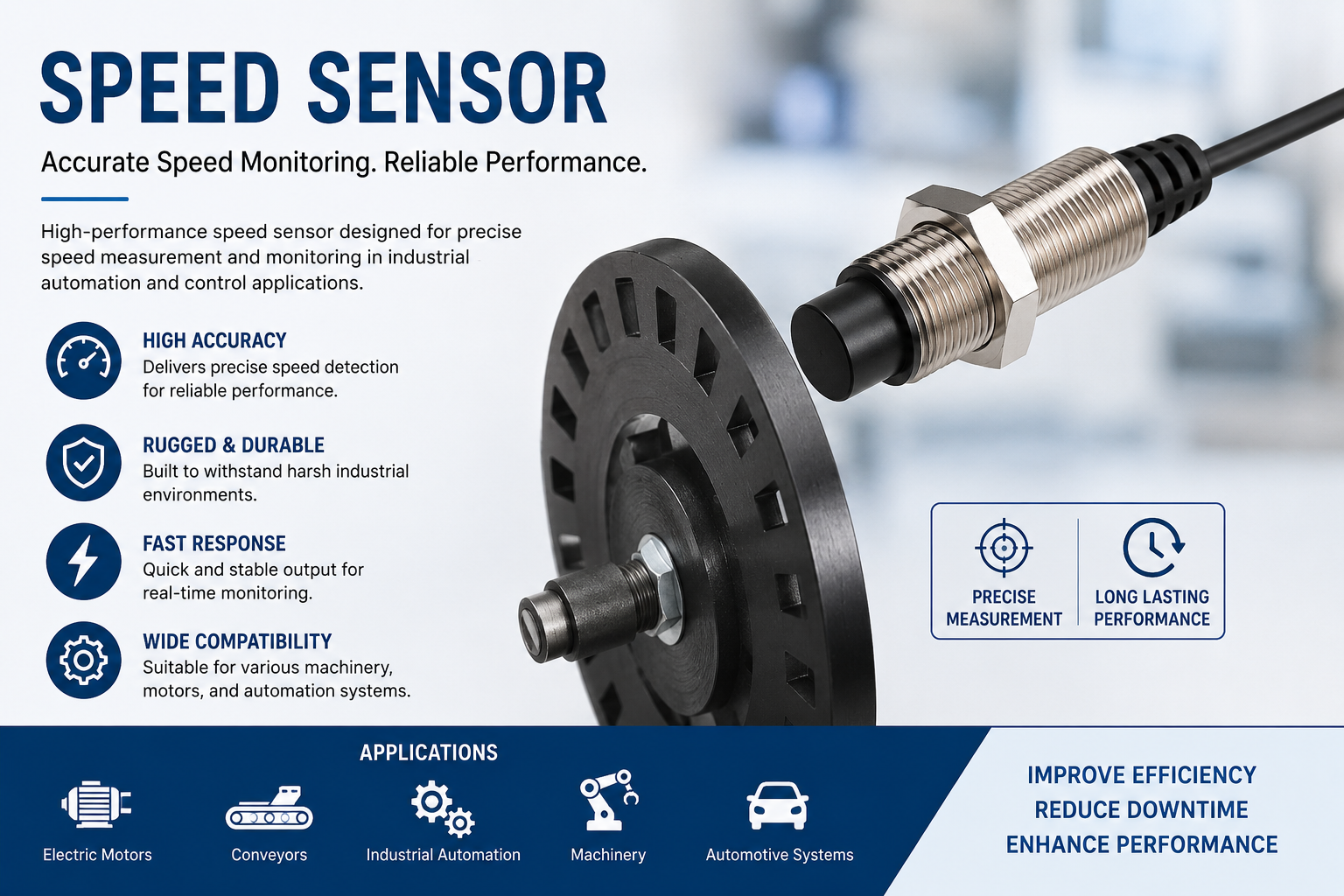
We provide speed sensors for a variety of purposes such as industrial automation, machinery An electronic instrument that determines the velocity of an object (such as a vehicle, rotating shaft, wheel, motor, etc.) through the use of sensors is referred to as a speed sensor. Speed sensors convert mechanical energy into electric signals that allow computerized controls, PLCs, etc., to process them. Basically, speed sensors give an accurate measure of how quickly something is rotating or moving.
Because of their reliability and efficiency, speed sensors are one of the most commonly used types of sensors.
monitoring or process control. see more
What is a Speed Sensor?
Simple Description
Speed sensors can be thought of as the ‘eye’ of the machine. Just as drivers look at a speedometer to find out how fast their vehicle goes, many industries use speed sensors for machine monitoring and control.
How Does a Speed Sensor Work?
A speed sensor’s basic function depends on a variety of factors, including the particular type of sensor and the way that it has been built. In general, all speed sensors utilize one of three basic operating principles: magnetic, optical or inductive.
When an object being tracked by a speed monitoring equipment moves past the sensor, an electrical pulse will be generated. The pulse will then be sent to the monitoring equipment for counting purposes.
Basic Working Process
- The sensor measures movement or rotation.
- It produces electrical signals or pulses.
- These signals are then transmitted to a controller or PLC.
- The system determines the speed.
- Speed information is shown in real time.
- The process is ongoing; hence, operators can always monitor the performance of the machinery.
Types of Speed Sensors
1. Magnetic Speed Sensors
Magnetic speed sensors use magnetic fields to detect rotating metallic objects.
Advantages:
- Durable design
- Non-contact operation
- Suitable for harsh industrial environments
- Low maintenance requirements
Applications:
- Industrial motors
- Automotive systems
- Gear monitoring
2. Hall Effect Speed Sensors
Hall Effect sensors detect changes in magnetic fields and convert them into electrical signals.
Advantages:
- High reliability
- Accurate measurements
- Compact size
Applications:
- Wheel speed monitoring
- Electric motors
- Industrial automation
3. Optical Speed Sensors
Optical sensors use light beams to measure speed and movement.
Advantages:
- Extremely accurate
- Fast response time
- Ideal for precision applications
Applications:
- Laboratory equipment
- Robotics
- Packaging machines
4. Inductive Speed Sensors
Inductive sensors detect metallic targets without physical contact.
Advantages:
- Long service life
- Resistant to dust and moisture
- Reliable performance
Applications:
- Manufacturing plants
- Conveyor systems
- Heavy machinery
Key Features of Modern Speed Sensors
Modern speed sensors are equipped with advanced technology that improves performance and reliability.
High Accuracy
Speed sensors provide precise measurements that help improve machine control and operational efficiency.
Real-Time Monitoring
Continuous monitoring allows operators to identify problems before they become major issues.
Non-Contact Sensing
Most speed sensors work without touching the moving object, reducing wear and extending sensor life.
Wide Speed Range
They can measure both slow and high-speed movements accurately.
Rugged Construction
Industrial speed sensors are designed to withstand vibration, dust, moisture, and extreme temperatures.
Applications of Speed Sensors
Automotive Industry
Speed sensors play a vital role in modern vehicles.
Common Uses:
- Wheel speed monitoring
- Anti-lock Braking Systems (ABS)
- Engine management systems
- Transmission control
Industrial Automation
Manufacturing facilities use speed sensors to improve production efficiency.
Applications:
- Conveyor belt monitoring
- Motor speed control
- Machine automation
- Production line optimization
Robotics
Robots require accurate speed feedback to perform tasks precisely and safely.
Renewable Energy
Wind turbines use speed sensors to monitor blade rotation and optimize power generation.
Transportation and Logistics
Speed sensors help improve efficiency and safety in railways, warehouses, and material handling systems.
Benefits of Using Speed Sensors
Improved Productivity
Accurate speed monitoring ensures machines operate at optimal performance levels.
Enhanced Safety
Speed sensors help detect abnormal operating conditions before accidents occur.
Reduced Downtime
Early fault detection minimizes unexpected equipment failures.
Lower Maintenance Costs
Predictive maintenance reduces repair expenses and extends equipment life.
Better Process Control
Real-time speed data helps operators maintain consistent production quality.
Increased Equipment Lifespan
Operating machinery at proper speeds reduces mechanical stress and wear.
Why Choose Sensormart Speed Sensors?
When selecting a speed sensor, quality and reliability are crucial. Sensormart offers advanced speed sensing solutions designed to meet the needs of modern industries.
Benefits of Choosing Sensormart
- High measurement accuracy
- Industrial-grade durability
- Easy installation
- Long operational lifespan
- Excellent performance in harsh environments
- Affordable pricing
- Professional technical support
Our speed sensors are trusted by industries across India for their dependable performance and long-term reliability.
Future of Speed Sensor Technology
With the rise of Industry 4.0 and Industrial IoT, speed sensors are becoming smarter than ever before. Future speed sensors will offer:
- Wireless communication
- Cloud connectivity
- Remote monitoring
- Predictive maintenance capabilities
- Advanced diagnostics
These innovations will help industries improve efficiency, reduce downtime, and increase profitability.
Conclusion
In terms of machine performance monitoring, the speed sensor is vital. The accurate speed measurement from the sensor will provide greater efficiency, enhanced safety, and reduced maintenance.
No matter the kind of business you run – factory, automobile, robot, or renewable energy system – a good quality speed sensor can make a significant impact on your operations.
Sensormart provides loading speed sensors that are both reliable and long-lasting to meet the needs of our clients and their operations. sensormart
Frequently Asked Questions (FAQs)
1. What is the function of a speed sensor?
A speed sensor is a device that detects the speed of rotation or movement of an object.
2. In which industries is the application of speed sensors common?
Speed sensors are used in automobiles, factories, robotics, conveyors, wind mills, and other industrial applications.
3. What are the common types of speed sensors?
There are mainly four types of speed sensors including magnetic sensors, Hall Effect sensors, optical sensors, and inductive speed sensors.
4. Why are speed sensors crucial for the autom
ated industry?
They are vital in enhancing the performance of machines, reducing the rate of machine breakdowns, increasing efficiency, and predictive maintenance.
5. Is it possible for speed sensors to operate under challenging industrial conditions?
Yes. Speed sensors made for the industrial sector are built to endure harsh conditions including dust, vibrations, moisture, and extreme temperatures.
6. Why should I go for Sensormart speed sensors?
Sensormart guarantees high precision, reliability, and durability in all its speed sensors at affordable prices.




Leave a Reply