
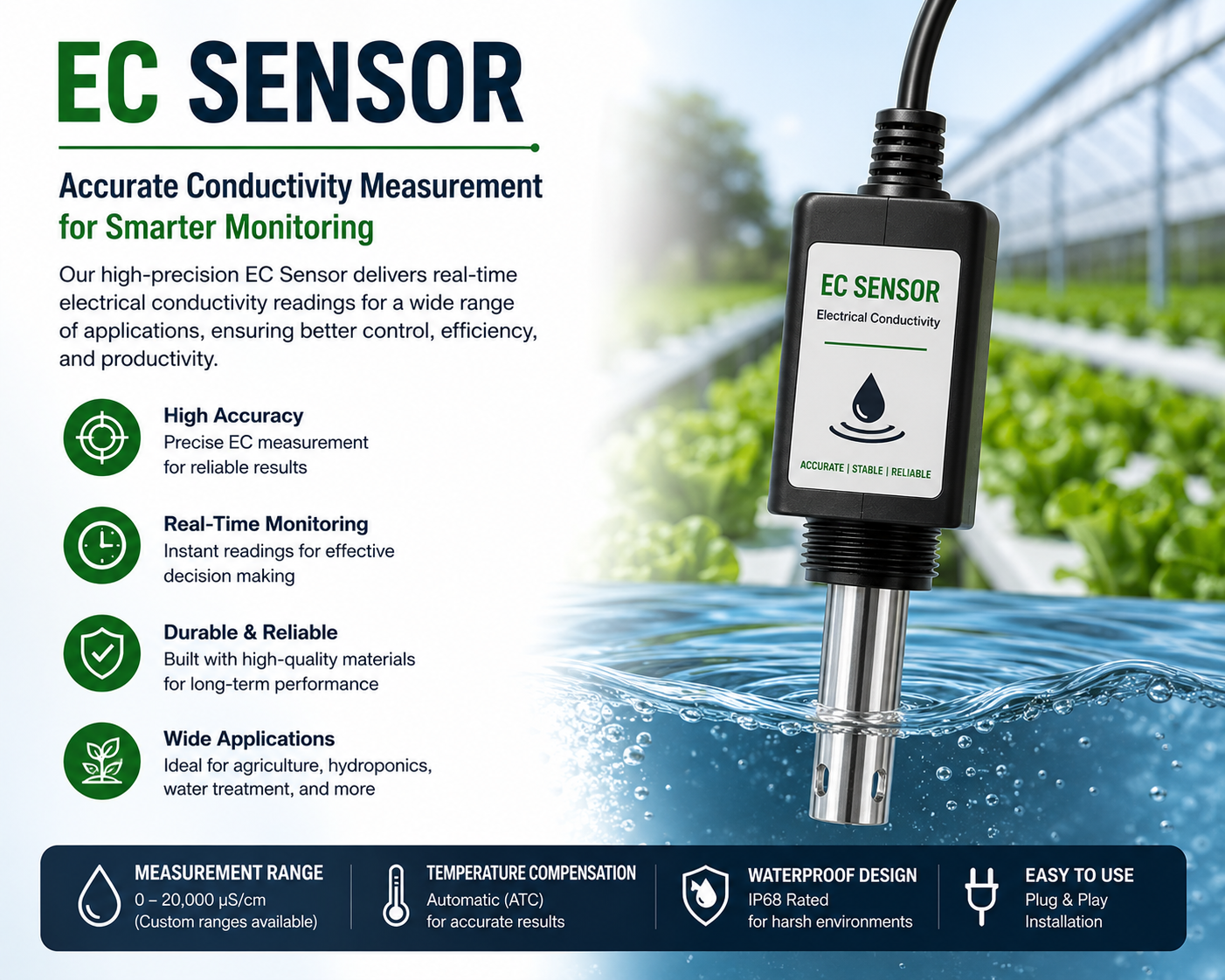
EC Sensor
An electrical conductivity sensor (EC sensor) is a very useful tool for measuring the amount of electrically conductible liquid. Electrical conductivity is a measure of the ability of a liquid to conduct electricity. The electrical conductivity of a solution can be measured by observing the number of dissolved salts/minerals and ions present in the liquid. The applications of EC sensors are diverse, such as agriculture, water treatment, hydroponics, environmental monitoring and many of the different industrial manufacturing processes. more detail
Sensor Mart offers a wide range of rugged, high-quality and precision EC sensors for your applications.
What you should choose: EC Sensor
The EC Sensor is a device that allows you to measure the ability of a solution to conduct an electric current (or how conductive it is). This is done by measuring the voltage between the electrodes of the sensor and then measuring the amount of current that flows due to that voltage. EC sensor measures the amount of dissolved solids (ions) in the solution, the higher the electrical conductivity reading will be.
The most common unit of measurement for electrical conductivity is:
- µS/cm (millionths of a siemen per centimetre)
- mS/cm (thousandths of a siemen per centimetre)
These measurements are useful in determining water quality, nutrient content and the amount of contaminants in the water.
How Does an EC Sensor Work?
An EC sensor consists of two or more electrodes placed in a liquid. When voltage is applied, ions in the solution carry an electrical current between the electrodes.
The EC sensor then:
- Measures the electrical resistance.
- Converts resistance into conductivity values.
- Displays accurate conductivity readings.
Modern EC sensors often include temperature compensation to ensure precise measurements under varying environmental conditions.
Key Features of EC Sensor
EC Sensors
EC sensors provide reliable conductivity measurements for critical applications.
Fast Response Time
They deliver real-time data for continuous monitoring systems.
Durable Construction
Designed to withstand harsh industrial and outdoor environments.
Temperature Compensation
Ensures accurate readings despite temperature fluctuations.
Low Maintenance EC sensor
Advanced sensor technology reduces calibration and maintenance requirements.
Applications of EC Sensor
Agriculture and Irrigation
Farmers use EC sensors to monitor soil and irrigation water quality. Proper conductivity levels help optimise crop growth and fertiliser efficiency.
Hydroponics
In hydroponic systems, EC sensors measure nutrient concentration in water, ensuring plants receive the correct nutrient balance.
Water Treatment Plants
Municipal and industrial water treatment facilities use EC sensors to monitor water purity and treatment efficiency.
Aquaculture
Fish farms rely on conductivity monitoring to maintain healthy aquatic environments.
Industrial Processes
Many manufacturing industries use EC sensors for process control, quality assurance, and chemical concentration monitoring.
Environmental Monitoring
Researchers and environmental agencies use EC sensors to assess river, lake, and groundwater quality.
Benefits of Using EC Sensor
Improved Water Quality Monitoring
Conductivity measurements help identify contamination and water quality issues early.
Enhanced Crop Productivity
Accurate nutrient monitoring improves agricultural output and resource utilisation.
Cost Savings
Real-time monitoring reduces waste, maintenance costs, and operational inefficiencies.
Better Process Control
Industrial users gain greater control over chemical concentrations and production quality.
Reliable Long-Term Performance
Modern EC sensors provide stable and consistent readings over extended periods.
Why Choose Sensor Mart EC Sensors? For accuracy, durability and performance, Sensor Mart is offering high-quality EC sensors. We use our sensors in Agriculture, Industrial automation, water treatment, hydroponics and environmental monitoring.
- The advantages of selecting Sensor Mart are that:
- High-precision measurement technology
- Robust sensor construction
- Competitive pricing
- Expert technical support
- Reliable after-sales service
- Customized sensing solutions
From agriculture to research and industrial applications, Sensor Mart provides reliable solutions to suit your needs when it comes to conductivity monitoring.
Sensor Mart
provides premium EC sensors that are accurate, durable and high-performing EC sensors. Our sensors are suitable for a variety of applications, including agriculture, industrial automation, water treatment, hydroponics and environmental monitoring. The advantages of selecting Sensor Mart include:
- High-precision measurement techniques
- Rigid Sensor Design
- Prices are reasonable
- Professional technical help
- Reliable after-sales service
- Custom sensing solutions
- So, if you’re looking for conductivity monitoring for agriculture, research or industrial processes, Sensor Mart has reliable solutions for your needs.
Maintenance Tips for EC Sensors
- for optimal performance
- Clean sensor electrodes often.
- Calibration in accordance with the manufacturer’s recommendations.
- To protect the sensing element(s) from physical damage.
- Store sensors properly when not in use.
- Calibrate with suitable conductivity standards.
- Regular maintenance will ensure accurate and long-lasting operation.
Conclusion
The EC Sensor is an important piece of equipment when it comes to monitoring water quality, nutrient concentrations and infective particle counts (IPC). Accurate conductivity measurement is required in many fields such as agriculture, hydroponics, wastewater treatment (water), aquaculture (large fish farms) and manufacturing. EC Sensors are very accurate, durable and perform well, which makes them great for both businesses and professionals who want to improve the accuracy of their measurements and make better decisions on how to run their company.
Purchasing an EC Sensor will provide you with accurate information, which will help you make better business decisions and ultimately save your company money over time. see more
Frequently asked questions (FAQs)
1. The electrical conductivity of a liquid is
measured by an EC sensor, which is used to determine the concentration of dissolved salts and ions
2. In what applications do you see EC sensors being used?
In agriculture, hydroponics, water treatment facilities, aquaculture, and laboratory and industrial applications, EC sensors are commonly employed.
3 . Why is agriculture concerned with conductivity?
Conductivity, which reflects the amount of nutrients available and the quality of irrigation water, directly affects the growth and yield of the crops.
4. What is the frequency of calibration for an EC sensor?
Frequency of calibration depends on the use of the instrument; regular calibration is recommended to ensure measurement accuracy
.
5. Is it possible to measure water purity with EC sensors?
Yes. The conductivity of water is often used to determine the purity of the water and to measure the presence of dissolved contaminants.
6. Why Sensor Mart EC sensors?
Sensor Mart’s EC sensor is supported by well-trained tech experts and reliable service. They aim for accuracy, durability, and cost-effectiveness, plus they offer solid technical know-how.



Leave a Reply