
What Is 2D Radar?
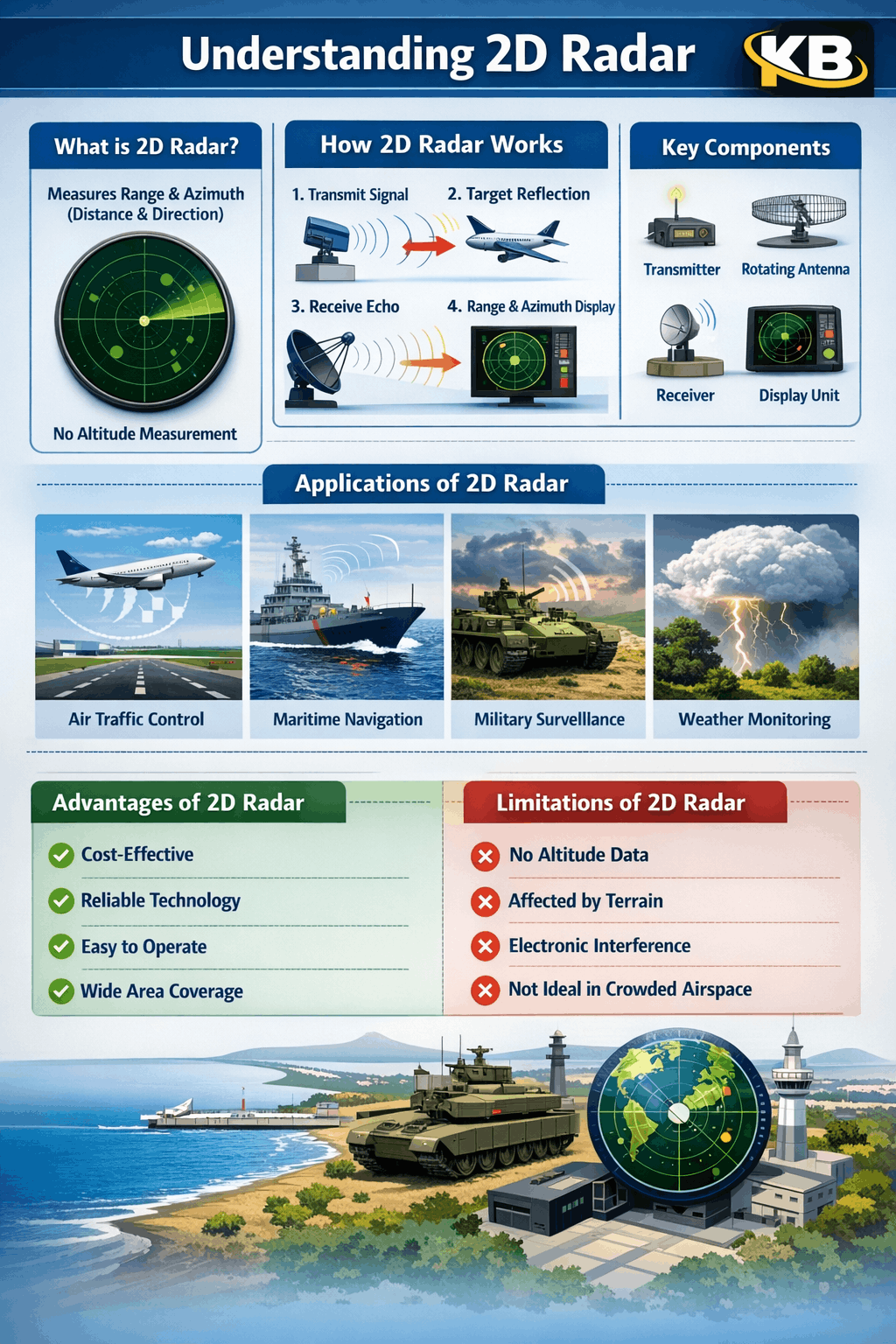
The 2D Radar (Two-Dimensional Radar) is a type of radar system that identifies and displays the range (distance) of a target and azimuth (horizontal direction) but not the altitude. It gives a two-dimensional image of the objects that it is in the coverage range and this makes it suitable in surveillance, navigation and tracking.
In contrast to 3D radar systems, radar is more aimed at horizontal scanning and is widespread in those sectors where altitude data is not required or received via other systems. Sensor Mart
How Does Radar Work?
A radar system functions through the sending of radio waves and the assessment of the reflected wave back on the objects (targets).
The simplified breakdown is as follows:
Transmission: The radar antenna emits the electromagnetic waves as pulses.
Reflection: When the waves strike an object, these waves (aircraft, ship, vehicle and terrain) are reflected.
Reception: The reflected signals are reflected and received by the antenna.
Processing: The radar system determines:
Range -Depending on the time delay in transmission and reception.
Azimuth- This depends on the direction in which the antenna is facing at the time of receiving the echo.
The outcome is put on a radar screen where targets appear as dots in a two-dimensional map.
Important Radar System Building blocks.
A typical 2D radar includes:
Transmitter: Produces radio waves of high frequency.
Antenna: Rotates horizontally to search the location.
Receiver: Sensors reflected signals.
Signal Processor: Removes noise and distance and direction.
Display Unit: Displays targets as 2D.
The antenna is generally rotated 360 degrees thus offering coverage to all areas.
Types of 2D Radar
1. Pulse Radar
Pulse radar emits bursts of energy and measures the seconds it takes the echo to return. It has a wide application in surveillance and air traffic control.
2. Continuous Wave (CW) Radar
CW radar is characterized by persistent emission of signal and is frequently utilized in an attempt of measuring speed e.g. in traffic checking.
Applications of 2D Radar
The radar can be applied in different industries because of its low cost and high reliability. Sensor mart
1. Air Traffic Control (ATC)
Airport primary surveillance radars are 2D radars that identify the position of the aircraft. Indicatively, organizations such as Federal Aviation Administration have systems that operate under radar technology to maintain a safe separation of aircraft.
2. Maritime Navigation
Ships also take the radar to identify other vessels, coastline, and other obstacles, particularly in the bad weather.
3. Military Surveillance
2D radar is used by defense systems to:
Border monitoring
Early warning detection
Target tracking
Raytheon Technologies and other companies develop several sophisticated radar systems to defend and survey.
4. Weather Monitoring
Radar is applied by meteorological departments to identify the patterns of precipitation and movement of storms. any query Sensor Mart
5. Traffic Monitoring
Radar systems are employed by the law enforcement agencies to check the speed of vehicles within highways.
Advantages of 2D Radar
1. Cost-Effective
The radar is cheaper to install and maintain as compared to the 3D radar systems.
2. Reliable Technology
Throughout the decades, it has been in operation, and it is very reliable.
3. Lower Complexity
It is simpler in design and therefore easy to operate and maintain.
4. Wide Area Coverage
Rotating antennas will have complete horizontal scanning.
Limitations of 2D Radar
Although radar is a good system, there are limitations associated with it:
❌ fails to offer information on the altitude.
❌ Not as effective in congested airspace.
❌ Terrain and obstacles have the ability to influence it.
❌ Easily interfered with electronically.
In order to surmount the limitation of altitude, certain systems are combined with the secondary radar or other sensors.
Radar Application in the Real World.
Airport radar systems are employed in the management of aircrafts in modern airports worldwide. Large airports such as the Heathrow Airport rely on radar systems to track the movement of planes in the controlled airspace.
Future Projections of the 2D Radar Technology.
Even with the development of 3D and phased-array radars, 2D radar is still developing:
Digital Signal Processing (DSP): Reduced miss outliers.
Solid-State Transmitters: More reliable and less maintenance.
Artificial Intelligence Addition: More intelligent threat detection and spam blocking.
Hybrid Systems: This involves the deployment of a combination of radar with other sensor technologies.
The modern 2D radar systems are becoming increasingly efficient and flexible with the integration of AI and sophisticated filtering technologies.
Why 2D Radar Still Matters in 2026
Although there are advanced radar systems, 2D radar is still very popular due to the following reasons:
It satisfies operational demands of numerous uses.
It is budget-friendly.
It has a track record of performance.
It can be easily integrated with contemporary systems.
The 2D radar remains as a viable solution to industries where altitude data is secondary.
FAQs
1. What does 2D radar measure?
The 2D radar measures the range (distance) and the horizontal direction (azimuth) but not the altitude of a target.
2. Where does 2D radar find application?
It is very much applicable in air traffic control, marine navigation, military surveillance, weather surveillance, and traffic speed surveillance.
3. What is the principal distinction between 2D and 3D radar?
The only significant distinction is that 3D radar measures the altitude as well as 2D radar does not.
4. Is 2D radar still used today?
The 2D radar is also very popular because it is cost-effective, reliable, and applicable in most surveillance systems.
5. Can 2D radar detect weather?
Yes, radar is able to measure precipitation and motion of storms, but more specific weather radars can be equipped with other functions.
6. Is 2D radar military compatible?
Yes radar is utilized by many military systems to monitor the border, provide early warning and bottom-based monitoring.
Conclusion
The radar is still one of the rudimentary technologies in surveillance and navigation systems around the globe. It is a significant source of aviation, maritime safety, military, and traffic monitoring by offering correct distance and directional information.
It is not the most accurate in measuring altitude as compared to 3D radar, but its simplicity, cheapness, and reliability have ensured that it is an option of choice in many applications. The radar systems will be effective and used over the years following the continuous advancement of digital processing and AI technologies.



Leave a Reply