
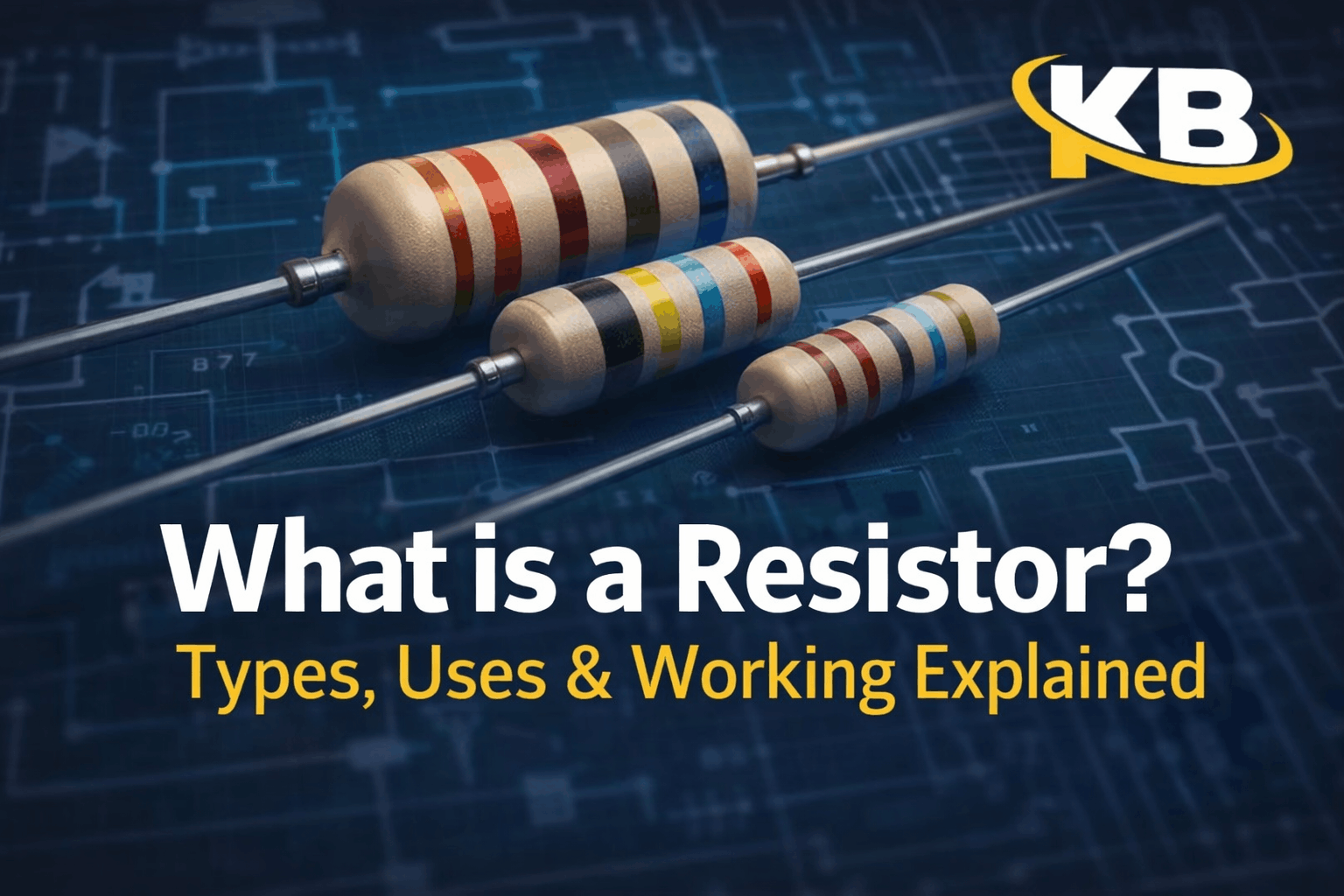
Resistor is one of the most important and popular elements in the electronics. In the simple circuit design and the complex electronic systems design, resistors are an important component of regulating the flow of electricity. We are Sensor Mart and we know how it is important to select the right resistor in order to ensure a reliable and efficient performance.
This SEO friendly document will make you know what resistors are, their mechanism, their types and how they are put in practice in the real world.
What is a Resistor?
A resistor is an electronic component with passive characteristics that restrict or controls the passage of electric current within a circuit. It assists in safeguarding the sensitive elements to make sure that the current does not exceed the safe levels.
The resistors are measured in ohms ( Ω ), which is a measure of the amount of resistance. The greater the resistance value, the lesser the current is conducted within the circuit. Our Website
How Does a Resistor Work?
The resistor operates according to the Ohm Law which is:
Voltage (V) = Current (I) x Resistance (R).
This implies that the amount of current flowing in a circuit can be manipulated by changing the resistance. The resistors dissipate the unwanted electrical energy as heat, which avoids the destruction of other parts.
Indicatively, in an LED circuit, a resistor is used to make sure that the LED is not supplied with excessive current and burns off.
Types of Resistors
Sensor Mart has a variety of resistors available to its customers in various applications. The most typical ones are the following:
1. Fixed Resistors
They are extensively utilized within electrical networks with a fixed value of resistance.
- Carbon film resistors
- Metal film resistors
- Wire-wound resistors
2. Variable Resistors
These can be adjusted to control the resistance value.
- Potentiometers
- Rheostats
Applied in volume controls, dimmers and tuning circuits.
3. Surface Mount Resistors (SMD)
They are miniature resistors that are used in PCB and automated assembly.
4. Thermistors
These resistors vary with temperature and they are applied in temperature measurement.
5. Light Dependent Resistor (LDR).
Their resistance varies according to the intensity of light, thus the light sensor and automatic light applications.
Applications of Resistors
Almost all electronic devices require resistors. It finds some of its major uses in:
1. Current Limiting
Shields such components as LEDs and transistors against excessive current.
2. Voltage Division
Traditionally used to measure voltage in smaller components in circuits.
3. Signal Conditioning
Modulates signal levels of sensors and communication systems.
4. Pull-up Resistors and Pull-down Resistors.
Stabilizes digital circuit logic levels.
5. Heating Elements
In high-power resistors the electrical energy is transformed to heat to be used in such applications like heaters.
At Sensor mart we offer resistors that can be used in all of these applications making it reliable and performing well.
Selection of the appropriate resistor.
The choice of the resistor is very important in circuit performance. These are the main aspects to be taken into account:
1. Resistance Value (Ohms)
Select according to your circuit demand.
2. Power Rating (Watts)
Make sure that the resistor is capable of working with thepower without overheating.
3. Tolerance
Indicates accuracy. Common values include ±1%, ±5%, etc.
4. Temperature Coefficient
Critical with circuits that are exposed to different temperatures.
5. Size and Type
Select through-hole or SMD according to your design.
At Sensor Mart we assist you in choosing the correct resistor to use in your project.
The benefits of quality resistors usage.
- Improved circuit stability
- Increased safety and protection.
- Accurate signal control
- Long-lasting performance
High quality components supplied by Sensor Mart would be used to achieve a long life and a uniform performance in all electronic uses.
There is no doubt that resistors will continue to be a vital and important component of modern electronics. Future of Resistors in Modern Electronics There is little doubt that resistors will remain an important and even essential element in the modern electronics.
As technology enhances, resistors are getting smaller, more accurate and effective. The current electronic devices require the use of high-performance resistors in their applications such as IoT devices, smart sensors and automation systems.
At Sensor Mart, we keep our inventory with new technologies of resistor and keep them up-to-date in accordance with the demands of the industry.
Conclusion
One of the basic building blocks of the electronic circuit is the resistors which make the circuits run smoothly. Their role cannot be overestimated since they allow the control of current, as well as the protection of sensitive devices. Be it a novice or an expert, the selection of resistor is important in order to create effective and dependable systems.
Sensor Mart offers a great variety of various high-quality resistors, and helps you bring your electronic projects to the next level. More blogs
FAQs
1. What does a resistor play the primary role?
A resistor restricts and regulates the movement of electric current through a circuit, to prevent the destruction of parts.
2. What is the calculation of a resistor value?
It can be computed by Ohm Law; Resistance (R) = V/I.
3. How will it affect the incorrect choice of the resistor value?
The incorrect resistor may lead to over heating, poor performance, or in case it is damaged, your circuit components may be damaged.
4. What is resistor tolerance?
Tolerance is given that shows how far the actual resistance can be out of the given value, normally in the form of a percentage.
5. In what applications do we find resistors?
The resistors are employed in the power supply, sensors, amplifiers, microcontrollers, and virtually all the electronic devices.
6. What makes Sensor Mart a better choice to purchase resistors?
Sensor Mart is a manufacturer of quality and reliable resistors, with professional help, Sensor Mart guarantees that you receive the best resistors to use in your application.






Leave a Reply