
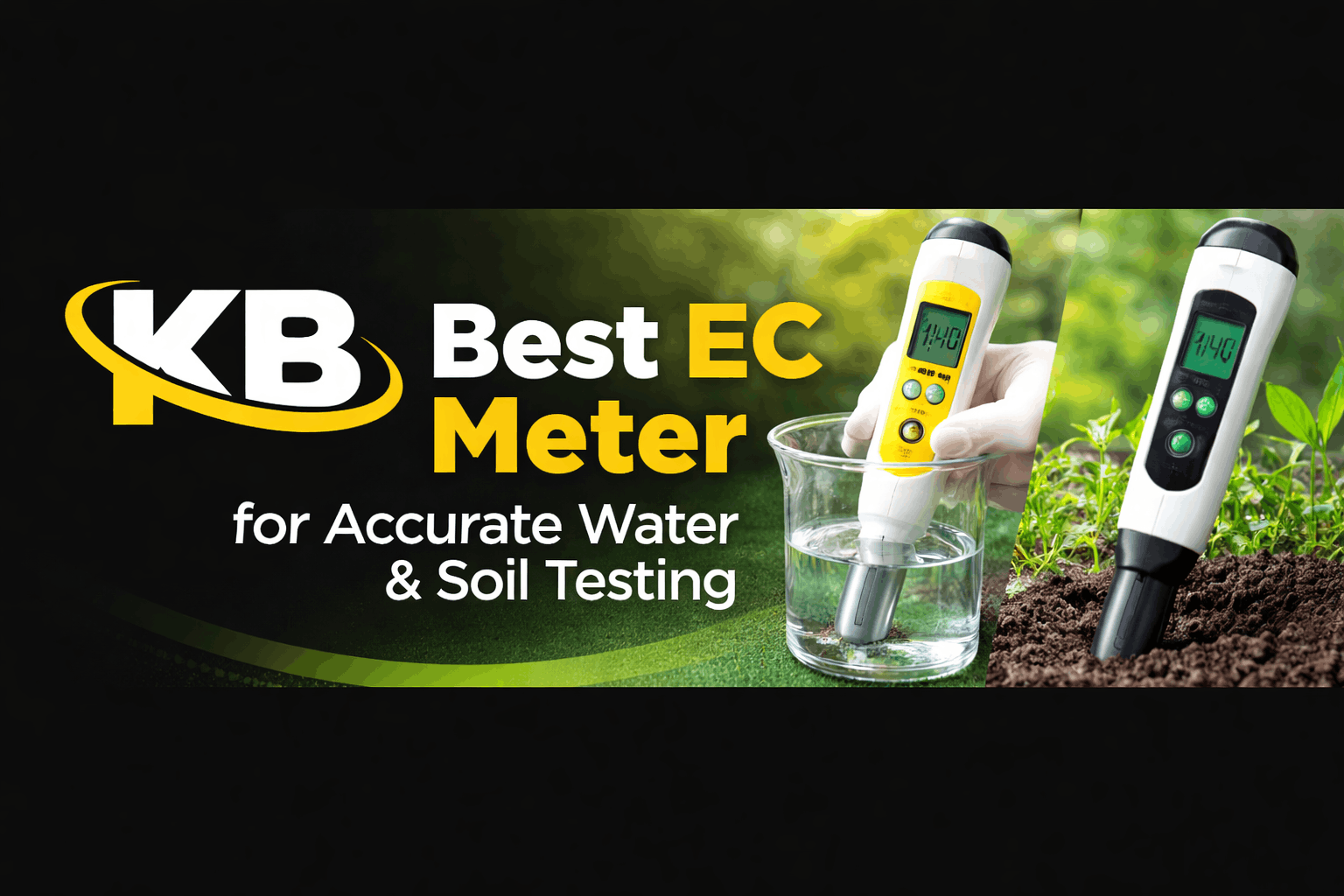
Whether managing commercial agriculture, operating a hydroponic farm, maintaining industrial water treatment systems, or analyzing environmental water samples, monitoring water purity and nutrient density is critical. An EC meter serves as the ultimate diagnostic tool for assessing liquid quality and dissolved ion content.
At Sensormart, we provide precision-engineered testing equipment designed to streamline fluid monitoring and maximize operational productivity. This comprehensive guide explores what an EC meter is, how it works, its diverse applications, calibration steps, and key benefits.
What Is an EC Meter?
An EC meter (Electrical Conductivity meter) is an analytical instrument designed to measure the electrical conductivity of liquid solutions or soil slurries. Electrical conductivity refers to a solution’s ability to conduct an electric current. Pure water is a poor conductor of electricity. However, as mineral salts, soluble ions, and nutrients dissolve into water, its ability to carry an electrical current increases proportionally.
By utilizing an EC meter, you can instantly determine the concentration of total dissolved salts without performing complex laboratory extractions.
Units of Measurement Used by an EC Meter
An EC meter typically reports measurements in the following standard scientific units:
- MicroSiemens per centimeter ($\mu S/cm$): Ideal for low-conductivity liquids such as purified water or rainwater.
- MilliSiemens per centimeter ($mS/cm$): Used for nutrient-dense liquids, irrigation water, and soil solutions ($1\ mS/cm = 1,000\ \mu S/cm$).
- DeciSiemens per meter ($dS/m$): Commonly used in agricultural soil testing ($1\ dS/m = 1\ mS/cm$).
An EC meter supplied by Sensormart provides real-time digital readouts in these standard units for instant field interpretation.
How Does an EC Meter Work?
Understanding the underlying mechanics of an EC meter helps users obtain accurate readings consistently.
An EC meter consists of a measuring unit connected to a specialized probe or electrode array. The core working mechanism relies on basic electrical principles:
- Current Application: The probe contains two or more electrodes (commonly constructed from stainless steel, platinum, or graphite). When submerged in a solution, the EC meter applies a small Alternating Current (AC) voltage across the electrodes.
- Ion Movement: Dissolved ions (such as sodium, calcium, nitrate, and chloride) migrate toward the oppositely charged electrodes, creating a measurable electrical path.
- Resistance & Conductance Calculation: The EC meter measures the resistance encountered by the electrical signal. Since electrical conductance ($G$) is the inverse of resistance ($R$), the instrument calculates conductance using Ohm’s Law:
$$G = \frac{1}{R}$$
- Cell Constant Factor: To convert overall conductance into specific electrical conductivity, the EC meter multiplies conductance by the probe’s cell constant ($K = \frac{d}{A}$), where $d$ represents distance between electrodes and $A$ represents their surface area:
$$\text{Conductivity } (\kappa) = G \times K$$
Modern units from Sensormart feature built-in Automatic Temperature Compensation (ATC). Because fluid conductivity increases with temperature, an EC meter automatically adjusts raw readings to a standard reference temperature of 25°C ($77^\circ\text{F}$).
Common Types of EC Meters
Choosing the right EC meter depends on your testing environment, required mobility, and automation needs. Sensormart offers a diverse inventory tailored to distinct operational workflows:
| EC Meter Type | Primary Features | Best For |
| Portable / Pen-Style EC Meter | Handheld, battery-operated, lightweight, waterproof. | On-site agricultural field checks, quick spot testing, spot monitoring. |
| Benchtop EC Meter | High precision, multi-parameter support, internal data logging, large display. | Scientific research labs, water quality control stations. |
| Inline Industrial EC Sensor | Continuous monitoring, Modbus/RS485 digital output, IP68 probe rating. | Hydroponic automation, water treatment plants, industrial processing. |
| Direct Soil EC Meter | Stainless steel rugged probes, multi-depth insertion, multi-parameter (Temp/Moisture/EC). | Precision farming, soil salinity checks, field crop management. |
Key Applications of an EC Meter
Because electrical conductivity correlates directly with ion concentration, the EC meter is utilized across numerous professional sectors:
1. Agriculture and Smart Irrigation
Farmers use an EC meter to evaluate soil salinity and irrigation water safety. Excessive salts in soil inhibit crop roots from absorbing moisture, causing physiological drought. Measuring soil slurries with an EC meter ensures fields maintain optimal fertility without salt accumulation.
2. Hydroponics and Vertical Farming
In soil-free farming, plants depend entirely on nutrient solutions. A hydroponic EC meter measures the precise concentration of fertilizers in the water reservoir. If the reading is too low, plants suffer from nutrient deficiency; if too high, root burn occurs. Using an EC meter from Sensormart helps maintain ideal nutrient balances for maximum crop yields.
3. Water Treatment and Environmental Testing
Municipal facilities, reverse osmosis (RO) plants, and wastewater treatment plants deploy an EC meter to evaluate water purity. An abrupt rise in conductivity signals chemical contamination, runoff, or pipe erosion.
4. Aquaculture and Fish Farming
Aquatic species thrive within specific osmotic limits. An EC meter helps fish farmers monitor salinity and ionic balance, preventing osmotic stress in sensitive aquatic organisms.
5. Industrial Process Monitoring
Cooling towers, boiler systems, and food processing facilities use an EC meter to monitor mineral build-up and prevent equipment scaling or boiler corrosion.
EC Meter vs. TDS Meter vs. pH Meter: Understanding the Differences
It is common to confuse an EC meter with a TDS (Total Dissolved Solids) meter or a pH meter. Understanding their distinctions ensures proper instrumentation.
- EC Meter: Measures actual electrical current carrying capacity in $\mu S/cm$ or $mS/cm$.
- TDS Meter: Estimates the total weight of dissolved solids in parts per million (ppm) or $mg/L$. In fact, most TDS meters are simply an EC meter that internally converts the conductivity value using a mathematical conversion factor (typically $TDS = EC \times 0.5$ to $0.7$).
- pH Meter: Measures the hydrogen ion activity to determine acidity or alkalinity on a scale of 0 to 14, completely separate from total salt concentration.
Combining a Sensormart pH instrument with a high-grade EC meter provides full diagnostic control over liquid chemical parameters.
How to Calibrate and Maintain Your EC Meter
To maintain high precision, periodic calibration of your EC meter is required. Electrode surface contamination or environmental changes can cause measurement drift over time.
[Prepare Standard Solution] ──> [Rinse Probe with DI Water] ──> [Submerge Probe] ──> [Adjust Calibration Setting]
Step-by-Step Calibration Procedure:
- Clean the Probe: Rinse the EC meter electrode thoroughly with deionized (DI) or distilled water. Gently pat dry using a lint-free wipe.
- Prepare Standard Solution: Select a fresh, certified conductivity calibration standard (e.g., $1413\ \mu S/cm$ or $12.88\ mS/cm$). Avoid re-using old calibration fluids to prevent cross-contamination.
- Submerge and Stabilize: Place the EC meter probe into the standard solution. Ensure no air bubbles are trapped against the electrode surface.
- Calibrate: Enter the calibration mode on your EC meter. Allow the automatic temperature compensation to stabilize, then confirm the reading once it matches the known standard value.
- Routine Storage: After testing, clean the probe with distilled water and store your EC meter in a safe, dry protective cap.
Major Benefits of Using a Sensormart EC Meter
Investing in a premium EC meter from Sensormart provides distinct operational advantages:
- High Accuracy & Speed: High-precision sensors deliver stable readings in seconds, accelerating field work.
- Durable Construction: Industrial-grade EC meter probes feature corrosion-resistant materials (such as IP68-rated enclosures and stainless steel probes) designed for harsh field environments.
- Cost Efficiency: Preventing over-fertilization in agriculture or scaling in industrial machinery saves significant resources.
- Automatic Temperature Compensation: Eliminates calculation errors caused by temperature fluctuations during on-site testing.
- Versatile Range: Sensormart offers customized solutions ranging from portable handheld devices to fully integrated RS485/Modbus industrial sensors.
Conclusion
Monitoring solution conductivity is vital for optimizing crop yields, maintaining industrial water systems, and ensuring environmental quality. An EC meter is an indispensable tool that translates invisible ionic activity into actionable, real-time data.
By choosing high-performance testing instruments from Sensormart, you equip your team with accurate, durable, and easy-to-use testing solutions designed to streamline workflows and boost productivity. Contact Sensormart today to explore our full line of advanced monitoring instruments and sensors. Our Website
FAQs
1. What is an EC meter used for?
An EC meter is used to measure the conductivity of a liquid, which indicates the concentration of dissolved salts and nutrients using the EC meter.
2. Why is EC important in agriculture?
EC helps determine soil fertility and nutrient levels allowing farmers to optimize irrigation and fertilization using the EC meter.
3. How often should I calibrate my EC meter?
It is recommended to calibrate your EC meter depending on usage to maintain accuracy for the EC meter.
4. Can EC meters measure water quality?
Yes EC meters are widely used to assess water quality in drinking water, wastewater and industrial applications using the EC meter.
5. What is the difference between TDS and EC?
EC measures conductivity while TDS estimates the total amount of dissolved substances based on EC values from the EC meter.
6. Are EC meters for hydroponics?
Yes EC meters are essential in hydroponics to maintain the nutrient concentration for plant growth using the EC meter.



Leave a Reply