
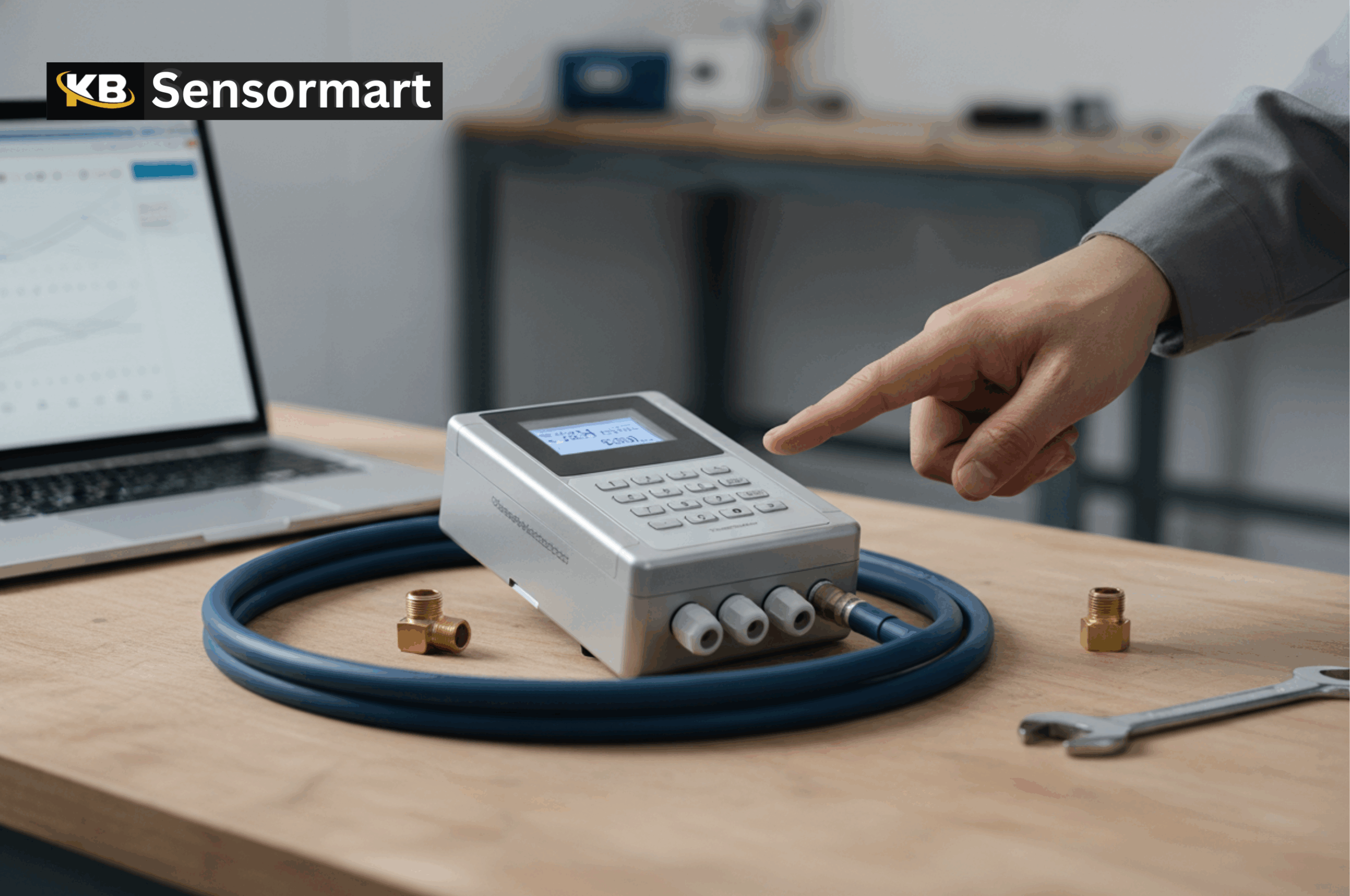
In India, about 40% of field technicians use portable flow meters every day. They need to be sure of their measurements, just like in a lab. I wrote this guide to show how a small flow meter can make a big difference. I’ll tell you what a portable flow meter does. I’ll explain how it works in the field. And why it’s a great choice for many industries in India. You’ll also learn about important features of handheld flow meters and see the SMKB-UF-215, a top ultrasonic option.
This guide will give you practical steps and clear information. It’s for anyone who needs reliable flow monitoring for maintenance, audits, or controlling processes. It will help you pick and use the right tool.
Key Takeaways
- Portable Flow Meter devices bring lab-grade checks to the field for faster diagnostics.
- I focus on handheld flow meter benefits for routine maintenance and audits in India.
- Portable flow monitoring reduces downtime and improves measurement confidence.
- This guide covers selection, installation, and the SMKB-UF-215 ultrasonic option.
- Expect practical, step-by-step advice aimed at technicians and procurement teams.
What is a Portable Flow Meter and Why It Matters
It’s a small tool that measures how fast liquids flow and their total volume. It works in pipes or open channels without needing to be installed forever. Handheld flow meter to places where it’s hard to stop work or get to. This device can be clamped on or inserted into pipes. It can measure flow in both directions and is easy to set up. This lets me check meters and find leaks fast. When I’m moving between different places in India, I use a mobile flow meter. It’s great because it’s easy to carry and saves time. Field teams use it for energy audits and to check for leaks without stopping work. Portable flow meters are also used a lot in water and wastewater treatment. They help balance flow and find where water is lost. In the oil and gas industry, they’re used for maintenance and temporary checks. Food and beverage, and pharmaceutical engineers use them for setting up systems and lab tests. In irrigation and agriculture, they help save water by measuring flow. HVAC technicians use them to balance water systems and check pump performance.
How Portable Flow Measurement Devices Work
I explain the basic principles behind common sensing technologies used in the field. Knowing how a portable flow measurement device senses flow helps technicians choose the right tool. This is for water, chemical, and industrial lines across India.
Overview of common sensing technologies
Ultrasonic, electromagnetic, turbine, positive displacement, and thermal mass sensors each serve distinct needs. Ultrasonic works well for non-invasive checks on clean liquids. Electromagnetic meters need conductive fluids and metal-compatible piping.
Turbine meters suit steady, low-particulate flows. Positive displacement units measure volumes in viscous fluids. Thermal mass sensors excel with gas flow and low rates. I recommend matching fluid type and pipe material to the sensing method to avoid costly errors in the field. For quick diagnostics, a portable flow sensor that supports multiple technologies can save time.
Transit-time ultrasound basics and why it’s accurate
It ultrasound sends pulses upstream and downstream and measures the travel time difference. The time difference maps directly to flow velocity. This gives high accuracy and repeatability for clean, homogeneous liquids.
Transit-time is bidirectional and non-invasive when used with clamp-on transducers. A handheld flow meter using transit-time delivers rapid readings without stopping the process. This makes it ideal for maintenance checks and temporary surveys.
Clamp-on versus insertion transducers explained
Clamp-on transducers attach to the pipe exterior. They require no process penetration and often need no shutdown. This makes a portable liquid flow meter practical for routine spot checks and leak diagnostics.
Insertion transducers place the sensing element directly into the stream. They provide stronger signals on dirty fluids and small diameters. Installation may need a tap or brief shutdown. For stubborn applications, an insertion unit improves signal strength and stability.
| Characteristic | Clamp-on | Insertion | Best Use with |
| Process penetration | No | Yes | Non-invasive checks vs. direct measurement |
| Installation downtime | Minimal | Requires tap or shutoff | Field surveys vs. permanent spot checks |
| Signal strength | Lower on dirty fluids | Stronger in challenging fluids | Clean liquids vs. slurries and small pipes |
| Suitability for portable units | High — used with portable flow sensor and handheld flow meter | Medium — used with portable liquid flow meter when strong signal needed | Temporary diagnostics vs. targeted measurements |
| Typical accuracy | Good for transit-time on clean pipes | Better in mixed-phase or high-turbulence flows | Accuracy needs guide selection |
Choosing the Right Handheld Flow Meter for Your Needs
I help technicians and teams pick the best handheld flow meter for field work in India. The right choice saves time, cuts down on mistakes, and keeps measurements right, no matter the site.
Assessing flow range and pipe compatibility
First, I check the flow speeds and pipe sizes needed on site. A good flow meter covers all flow speeds and fits all pipe sizes. For example, some meters handle 0–12 m/s flow and fit pipes from DN 25 mm to DN 1000 mm.
I also check if the meter works with different pipe materials. This avoids problems with sound or contact.
Required accuracy, repeatability, and linearity considerations
Next, I match the meter’s specs to the job. For precise work, I look for meters with high accuracy and low error. A meter with ±1% accuracy and 0.2% repeatability is perfect for detailed work.
I also plan for environmental effects and sensor changes. This ensures the meter meets site standards.
Power, display, and communication features to look for
I look for meters that offer flexible power options. Battery power is great for remote work, while DC or AC options are better for fixed locations. A clear LCD display is essential for reading in sunlight.
For data, I need analog and pulse outputs, and serial links like RS-232 or RS-485. This makes logging and integration easy.
Ergonomics and durability come last. A meter that’s easy to hold and durable is best. I check the keypad, mount points, and weight to make sure it’s practical for daily use.
| Selection Factor | Why it Matters | Minimum Recommendation |
| Flow range & pipe size | Ensures meter covers minimum and peak velocities and fits pipe diameters | 0–12 m/s range; DN 25–1000 mm support |
| Pipe material compatibility | Affects sensor coupling, signal strength, and accuracy | Steel, stainless, PVC, lined pipe support |
| Accuracy, repeatability, linearity | Defines trustworthiness for billing and process control | ±1% accuracy; 0.2% repeatability; ±1% linearity |
| Power options | Determines deployment flexibility in the field | Battery + 10–36 VDC; optional AC 90–245V |
| Display | Improves readability under sun and in confined spaces | 240×128 graphic LCD or better |
| Communication & I/O | Enables logging, remote reading, and system integration | 4–20 mA, 0–10 kHz pulse, RS-232/RS-485 Modbus |
| Ergonomics and durability | Reduces operator fatigue and field failures | Membrane keyboard; rugged housing; lightweight design |
SMKB-UF-215: A High-End Ultrasonic Option for Portable Flow Monitoring
I’m going to tell you about the SMKB-UF-215. It’s great for field engineers in India who need a reliable portable flow meter. It’s small but accurate, perfect for checking flow on the go. The SMKB-UF-215 is made for quick setups and checks. It’s perfect for checking flow during plant setup, service calls, and utility checks. It works fast, so you don’t lose time.
The SMKB-UF-215 uses a special method to measure flow. It looks at how sound travels before and after it hits something. This method is accurate and works well in noisy places. Inside the SMKB-UF-215, there’s a special chip called an Intel FPGA. It makes the device faster and more accurate. This is important because it helps the device work well even in noisy places. The SMKB-UF-215 comes with two types of sensors. Clamp-on sensors let you check without stopping the process. Insertion sensors are better for small pipes or fluids.
I’ll share the benefits for field technicians.
- Rapid setup for quick checks with the portable flow sensor.
- Flexible deployment across many sites with the portable flow meter.
- Reliable data for reports and records during monitoring.
Technical Specifications That Affect Field Performance
I check the key specs for a portable flow meter’s field performance. Range, accuracy, and durability are key. These numbers help field teams in India make the right choice.
Performance metrics: flow range, accuracy, repeatability, linearity
First, I look at the flow range. The SMKB-UF-215 can handle 0–12 m/s bidirectional. This covers slow flows to fast industrial speeds. Accuracy is crucial for spot checks. The unit is off by ±1% of the measured value. This is good for process control and leak detection. Repeatability is tight at 0.2% of the measured value. This means less need for repeated tests. It also builds trust in trend spotting.
Linearity is ±1%, keeping measurements consistent across the range. These specs make the meter useful for different pipe systems.
Pipe size compatibility from DN 25 mm to DN 1000 mm
The SMKB-UF-215 works with diameters from DN 25 mm to DN 1000 mm. It uses matched sensor pairs. This range is useful for many applications. Choosing the right transducer and mounting is key. Clamp-on sensors are good for noninvasive checks on big pipes. Insertion sensors work well for smaller lines.
Environmental ratings: temperature and humidity tolerance
Field use in India needs strong environmental specs. The electronics and display can handle up to 99% RH non-condensing. This covers coastal and monsoon areas. Temperature limits depend on the transducer and mounting. Always check the transducer’s temperature rating before choosing. This is important for hot or cold systems. Seals and enclosure design must fit site conditions. A compact flow meter with proper protection keeps accuracy high and extends life.
I suggest trying out devices in person. A portable flow meter that meets these specs is great for many tasks. Field teams often look for a balance of precision, range, and toughness.
Connectivity, Outputs, and Data Handling for Portable Flow Sensors
I explain how a portable flow sensor connects to data systems and field equipment. It has clear outputs and flexible power. This makes it useful in many places in India.

I give details to help engineers and technicians pick the right setup. The SMKB-UF-215 supports standard signals for working with data loggers and control panels.
Analog and pulse outputs (4-20mA, 0-10KHz)
A 4–20 mA analog output works well with most plant systems. It can handle up to 750 Ω, making wiring easy.
Pulse output up to 0–10 kHz is great for totalizers and batch control. It lets an on-the-go flow meter send flow-proportional pulses to loggers and verification tools.
Serial communication options: RS-232 and RS-485 Modbus
RS-232 connects directly to laptops and field PCs for quick setup and data download. This is handy for site checks with a handheld flow meter.
RS-485 with Modbus is good for multi-drop networks and SCADA integration. It’s useful for temporary networked deployments and long-term monitoring on one cable bus.
Power options including 10–36VDC and AC 90–245V
I talk about flexible power choices for better field use. A 10–36 VDC range works with vehicle batteries and local DC supplies for true portability.
AC 90–245 V input lets teams use standard mains anywhere. This reduces the need for extra adapters when the on-the-go flow meter moves.
| Feature | Benefit for Field Use | Typical Use Case |
| 4–20 mA analog output | Universal compatibility with PLCs and DCS; simple wiring | Short-term process checks and integration with plant control |
| Pulse output (0–10 kHz) | High-resolution totalizing and batching; external logging | Flow verification and portable batch dispensing with handheld flow meter |
| RS-232 serial | Direct PC connection for config and downloads | Field setup and troubleshooting using a laptop |
| RS-485 Modbus | Multi-drop networking and SCADA integration | Site commissioning and temporary networked monitoring with on-the-go flow meter |
| 10–36 VDC power | Supports vehicle/inverter use and DC site supplies | Remote locations and mobile test rigs using portable flow meter |
| AC 90–245 V power | Works with standard mains worldwide | Laboratory benches and fixed test points during field campaigns |
Design Features That Improve Usability On-The-Go
I test handheld instruments in different places in India. How easy they are to use makes a big difference. Good design helps me work faster and keeps data clean.
A clean setup is important to me. The SMKB-UF-215 has a special cover that hides screws. This stops things from getting caught and makes it harder for people to mess with it.
The graphics LCD on newer models changes how I see results. It shows flow, totalizer, and trends all at once. This makes it easier to read, even in bright or dim places.
Durable controls make quick checks faster. Membrane keyboards last longer and feel good to use for a long time. The sealed keypad keeps out dust and water, which is key in many Indian plants.
Clear interfaces are crucial when I move between sites. Easy-to-use keys, clear graphics, and a safe design all help. They make field work faster and more reliable.
| Feature | Benefit for Field Use | Why it matters for portable flow monitoring |
| Patented concealed cover | Reduced snagging, improved IP rating | Makes the portable flow meter robust for outdoor and dusty Indian sites |
| 240 × 128 graphics LCD | Clear trend views, easier diagnostics | Speeds decision-making during mobile checks with a compact flow meter |
| Membrane keyboard | Longer life, sealed against moisture | Maintains reliability of the portable flow measurement device in harsh conditions |
| Ergonomic layout | Faster operation, fewer entry mistakes | Reduces time on-site for routine portable flow monitoring and audits |
Field Setup, Calibration, and Best Practices for Mobile Flow Meters
I work with technicians across India to set up a portable flow meter. We aim for reliable data from the start. Choosing the right site, cleaning surfaces, and aligning properly saves time.
I often use a handheld flow meter for quick checks. This helps before we start longer measurements.

Step-by-step clamp-on installation tips
I look for a straight pipe run with minimal fittings or valves nearby, following the manufacturer’s guidelines for required pipe lengths.
Before installation, the pipe is cleaned thoroughly, and coupling compound is applied as instructed. The clamp-on flow meter transducers are positioned along the pipe’s axis line with the correct spacing for the pipe diameter.
Once placed, the clamps are tightened just enough to secure the transducers without over-torquing. The acoustic signal strength is then checked on the instrument and adjusted until the readings stabilize. For short measurement campaigns, magnetic holders or temporary straps help speed up the setup process.
Insertion sensor installation and sealing considerations
I look for a good insertion point that allows safe access and lets me drain or depressurize the line when needed. When a hot tap is required, certified procedures and safety steps are followed.
For fittings, ball valves or compression saddles are used and tightened to the proper torque to prevent leaks. Immersion depth and sensor orientation are checked against the sensor specifications to avoid false readings caused by wall effects or swirling flow.
Before and after installation, the line is inspected for buildup or debris. When fouling is expected, the setup is planned so the probe can be removed and cleaned easily, helping extend the life of the insertion probe and the portable flow measurement device.
Calibration checks, verification, and routine maintenance
After installation, zero and offset checks are run and the portable device output is compared with a known reference or a permanent meter when available. Repeatability is verified by taking multiple readings under stable flow conditions.
During each site visit, transducer faces, coupling paste, and cable integrity are inspected. When signal degradation appears, surfaces are cleaned and coupling compound is reapplied, and any drift is documented so units needing lab calibration can be flagged.
Periodic verification is scheduled against calibration standards—especially when measurements support regulatory reports or custody-transfer decisions. With regular maintenance, a clamp-on or handheld flow meter remains accurate and delivers a longer service life.
| Task | Action | Frequency |
| Site selection | Choose stable pipe run with minimal disturbances | Before each campaign |
| Transducer prep | Clean surface and apply coupling compound | At installation and as needed |
| Alignment check | Verify axis alignment and spacing for pipe size | At installation |
| Signal verification | Confirm acoustic strength and stable readings | Immediately after mounting |
| Leak prevention | Use correct fittings and torque for insertion sensors | At installation |
| Calibration validation | Compare against reference meter and run zero checks | Monthly or per regulatory need |
| Routine inspection | Check cables, transducer faces, and coupling paste | Every visit |
| Cleaning | Remove buildup from immersion probes and pipe surface | As required |
Cost, ROI, and Selecting a Compact Flow Meter for India
This guide explains how to choose the best compact flow meter for India, covering both cost and benefits, and clarifying when a portable or mobile flow meter is the right choice for field teams.
The evaluation includes the total cost of ownership—looking not only at the initial purchase price but also at long-term savings. Local support and easy procurement are also factored in, since they strongly influence lifetime costs.
High-accuracy flow meters are treated as long-term investments. A quality portable device, such as a transit-time flow meter, may come with a higher upfront cost, but the payoff comes through reduced downtime, fewer measurement errors, and quicker setup in the field.
Accurate readings help avoid losses from leaks and billing mistakes. They also mean fewer visits to the site.
I add accessory and service costs to my calculations. This includes transducer pairs, mounting kits, calibration, and training. I forecast these costs for the first three years to show the real return on investment.
When to choose a compact or mobile flow meter vs. permanent systems
I pick a compact flow meter for quick checks, commissioning, or temporary monitoring. A portable flow monitoring unit is great for many sites and seasonal work. A mobile flow meter is flexible for checks during plant maintenance.
I choose permanent meters for ongoing data, high accuracy, or automated control. Often, I use a portable meter with a permanent one for checks and troubleshooting.
Procurement considerations and local support in India
I look for vendors with a presence in India for quick spare parts and replacements. Local calibration and on-site setup save time and money. I check warranties and training to lower downtime risks.
I prefer suppliers with clear service networks, quick support, and easy access to parts. This keeps my flow meters running well and helps manage costs across projects.
Conclusion
Choosing the right Portable Flow Meter is key. It’s about matching technical specs to real field needs. Always check the flow range, accuracy, and pipe compatibility before buying.
The SMKB-UF-215 is a top choice for many. It uses TGA transit-time difference technology for stable results. It also has clamp-on and insertion transducers for different tasks.
For handheld use in India, check the device’s communication and power needs. Look for 4–20 mA, pulse outputs, RS-232/485, and 10–36 VDC or 90–245 VAC. Also, a graphic LCD, membrane keypad, and secure cover are important for reliability.
Next, use the tips from earlier sections. This will help you choose the best vendor and plan installations. It also ensures your device works well on the go.
Visit Sensormart today and explore reliable Portable Flow Meter options made for beginners and professionals alike.
FAQ
What is a portable flow meter and when should I use one?
A portable flow meter is a small, easy-to-carry device. It measures how fast liquids flow and the total volume. I use them for quick checks and when a permanent meter isn’t practical.They’re great for measuring flow on the go in many places. This includes water utilities, HVAC, and more in India.
What sensing technologies are common in handheld flow meters?
Handheld flow meters use different ways to sense flow. Ultrasonic, electromagnetic, turbine, positive displacement, and thermal mass are common.For accurate flow of clean liquids, ultrasonic transit-time is best. Electromagnetic is good for conductive liquids. Turbine and positive-displacement work for steady flows.
How does transit-time ultrasound work and why is it accurate?
Transit-time ultrasound sends ultrasonic pulses in two directions. The time difference shows how fast the liquid is moving. It’s accurate and non-invasive, making it reliable for many liquids.
What’s the difference between clamp-on and insertion transducers?
Clamp-on transducers attach to the outside of the pipe. They’re easy to use and don’t need to shut down the system. Insertion transducers go inside the pipe for better signal strength.Clamp-on is quicker, while insertion is better for tough fluids or small pipes.
How do I choose the right portable flow meter for my site?
First, match the flow meter’s range and compatibility to your site. Make sure it fits your pipe sizes and flow rates. Check the meter’s power options, display, and communication features.For precise measurements, look for high accuracy and repeatability. This is important for billing or custody-transfer tasks.
What are typical performance specs I should check?
Look for the flow meter’s range, accuracy, and how well it repeats measurements. Also, check if it fits your pipe sizes and can handle your environment’s temperature and humidity.
What connectivity and outputs should a portable flow meter offer?
A good portable flow meter should have analog and pulse outputs. Serial options like RS-232 and RS-485 with Modbus are also useful. Having flexible power options makes it easier to use in different settings.
What features improve usability in the field for a compact flow meter?
Look for a clear display, a durable keyboard, and a design that resists dust and moisture. These features make it easier to use in the field and protect it from damage.
How should I install clamp-on transducers for best results?
Choose a straight section of pipe for the installation. Clean the pipe and apply coupling compound. Align the sensors and secure them without over-tightening.Check the signal strength before finishing. Use temporary straps or magnetic holders for quick checks.
What are the key steps for insertion sensor installation?
Find a good spot for the insertion point and prepare the pipe if needed. Fit the sensor with the right fittings and ensure it’s at the right depth and orientation.Seal it well to prevent leaks and check for any blockages.
How often should I verify or calibrate my portable flow meter?
Do regular checks, especially before big projects or after rough handling. Make zero/offset checks and compare to a known reference if you can. Reapply coupling paste and inspect the transducer and cables.Calibrate it periodically for accurate measurements, especially for official work.
When does it make financial sense to buy a high-end portable meter like the SMKB-UF-215?
A high-end portable flow meter is worth it if it saves money in the long run. If you do a lot of checks and troubleshooting, a device like the SMKB-UF-215 can pay off. It saves time and improves your confidence in measurements.
What makes the SMKB-UF-215 suitable for field and mobile flow meter tasks?
The SMKB-UF-215 uses advanced ultrasonic technology and signal processing. It supports a wide range of pipe sizes and flow rates. Its accuracy and repeatability make it perfect for on-the-go use.
What procurement and support considerations should I check in India?
Look for vendors with local support and spare parts. Check their warranty, training, and lead times for accessories. Good local support means less downtime and easier maintenance.
Can a portable flow meter replace permanent meters for all tasks?
Portable flow meters are great for quick checks and temporary use. But for ongoing monitoring or billing, a permanent system is better. Portable meters are useful for verifying and calibrating permanent installations.
Are portable flow meters suitable for humid or harsh environments in India?
Many portable flow sensors can handle high humidity and harsh conditions. Look for ones with sealed keypads and connectors. Make sure the temperature range matches your application.


Leave a Reply