
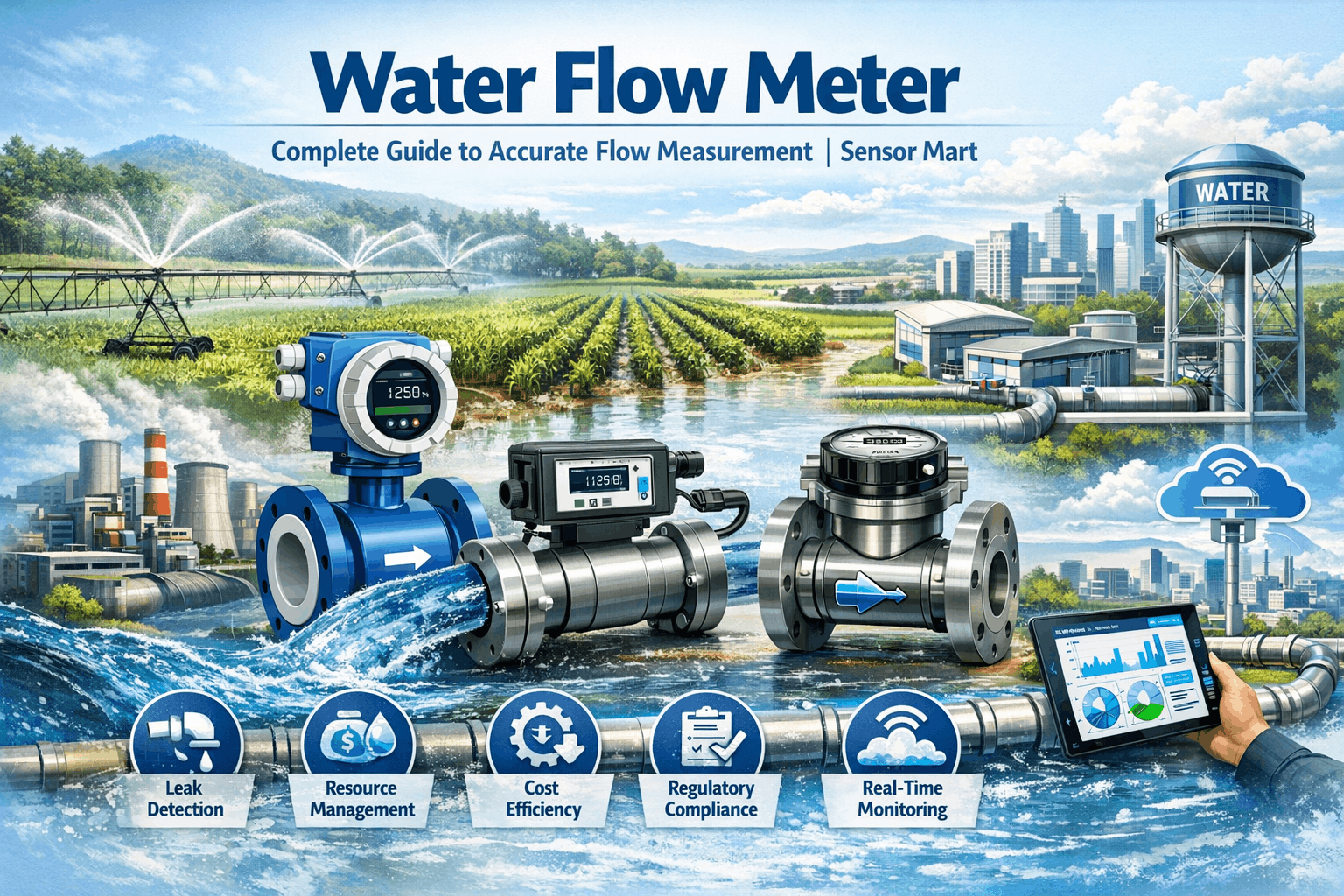
Complete Guide to Accurate Flow Measurement | Sensor Mart
In today’s industries, farming, and water management, accurately measuring the flow of water is essential. A Water Flow Meter is one way to measure how much water is being used in a system or where it comes from if it is safe to drink. Flow meters are used in all types of water systems, from agriculture and factories to municipal water distribution, so using a flow meter can help provide accurate measurements to run an efficient system, manage resources, and control costs.
At Sensor Mart, we manufacture a wide range of top-quality water flow meters to measure the volume and amount of water flowing at many different flow rates. This guide will provide you with important information about water flow meters, including how they work, the various types of water flow meters available, what the applications for these meters are, and the benefits of water flow meters.
What is a Water Flow Meter?
The Flow Meter for Water is a tool designed to track how much or how quickly water is flowing through a pipe or open channel. It allows you to monitor usage, identify leaks and manage water resources effectively.
Water flow meters are commonly found in:
- Water distribution systems
- Industrial facilities
- Irrigation and agriculture
- Sewage treatment facilities
- Commercial properties
- Smart city systems
Today’s modern Sensor Mart water flow meters give precise, real-time readings and can be integrated easily into storage devices or other monitoring equipment.
Why Water Flow Measurement is Important
Monitoring the quantity of water that flows through a facility is critical to the successful and effective management of water from a facility and operational performance.
1) Reducing the Amount of Water Used
When you have an accurate measure of how much water you consume, you can detect any unnecessary usage of water.
2) Detecting Leaks
Unanticipated changes in the amount of water flowing through pipes indicate a problem with pipes or a failure in the system.
3) Managing Costs
By effectively managing water consumption, industries will be able to maximize profit by decreasing operational costs.
4) Enhancing Operational Performance
Water flow measurement procedures will assist in assuring that processes operate consistently the same way.
5) Meeting Regulatory Compliance
There are many different industrial processes that must monitor their water consumption to comply with local environmental laws.
Sensor Mart provides the latest in advanced water flow measurement systems to help you monitor your water resources.
How Does a Water Flow Meter Work?
A water flow meter determines either the speed (velocity) or amount of water that passes through a pipe by converting the physical motion of the water into usable data. The water flowing through the pipe enters the meter, where it will be measured by internal sensors or mechanical devices to determine the speed (velocity) of the water as it passes through the device and the flow direction of the water; then these measurements are converted to usable data for your use by way of being transmitted to the display device (i.e. digital display, analog display, etc.); at the same time, the flow meters from Sensor Mart have advanced features that allow them to send real-time readings to either data logging devices or cloud, allowing for remote monitoring of both your facility or home and the meters.
Types of Water Flow Meters
- Water flow meters types and uses are changing as technology advances. Here are four most common types of water flow meters:
1. Electromagnetic Flow Meter
Electromagnetic flow meters use an electromagnetic field to measure the flow of water. These are very popular in several applications such as: water treatment, wastewater, and industrial.
Benefits
high level of accuracy;
no moving parts;
ideal for conductive fluids like water; and
Sensor Mart carries dependable electromagnetic flow meters for industrial and municipal water monitoring.
2. Ultrasonic Flow Meter
Ultrasonic flow meters utilize sound waves to determine the velocity of the flowing water.
Advantages
non-invasive measurements;
high degree of precision; and
simple installation methods.
Ultrasonic flow meters can be found in many applications including water supply, irrigation, and industrial piping systems.
3. Mechanical Water Flow Meter
Mechanical flow meters measure the flow of water using rotating parts, such as turbines or paddles.
Benefits
cost-effective;
simplistic design; and
sufficient for basic measurement of water flow.
4. Turbine Flow Meter
Turbine flow meters are similar to mechanical meters, but instead of using rotating elements they use a rotor (turbine) to measure the velocity of flowing water.
Commonly used for:
Industrial water measurement systems;
fuel measurement; and
chemical processing.
Applications of Water Flow Meters
Water flow meters are critical components in numerous industries as well as various infrastructure systems. Farmers rely on these instruments to track and manage how much water they use for irrigating crops in order to reduce water usage and improve efficiency by optimizing the amount of water used for irrigation. Sensor Mart offers a line of industrial-grade water flow meters specifically designed for use in agricultural water management systems.
In addition, industrial processes (e.g., cooling systems) need accurate water measurements to determine when water is supplied properly to the process(es) and will function satisfactorily. A water flow meter will ensure that there is a steady flow of water, which maximizes efficiency within an industrial process.
Municipal water supply companies utilize flow meters to assess the distribution of water throughout their systems. This enables them to find leaks along the lines and manage their water delivery more effectively.
Wastewater treatment facilities utilize flow meters to monitor the flow of wastewater throughout the treatment process to ensure that they comply with all regulatory requirements and to ensure the proper treatment of wastewater.
Smart cities today incorporate modern digital water flow meters as part of their Internet of Things (IoT) enabled infrastructure; they utilize these devices to monitor the amount of water being consumed and optimize their water distribution networks. Sensor Mart has various products that can be utilized by smart cities in order to improve their water metering capabilities.
Benefits of Using Sensor Mart Water Flow Meters
The Water Flow Meter Selection is important for reliability and performance in the long-term.
Some of the features of Sensor Mart water flow meters include:
High Accuracy:
Sensor Mart flow meters accurately measure the amount of water being used in critical applications.
Ruggedness:
Designed to withstand harsh industrial environments. More Blogs
Real-Time Monitoring:
Many Sensor Mart flow meters can be remotely monitored and collect data digitally.
Reliable Installation:
Sensor Mart water flow meters are manufactured to allow for quick and easy installation with little to no maintenance needed.
Applications for Sensor Mart Products:
Suitable for many applications including agriculture, industrial systems, water treatment facilities, and municipal water systems.
Tips for Choosing the Right Water Flow Meter
Choosing a water flow meter requires an evaluation of 5 primary factors:
Size of pipe & installation method
Flow Rate Range
Precision standards
Environmental conditions
Connectivity and data monitoring capabilities
SensorMart ensures their expert staff will work with customers to help select the appropriate water flow meter for any specific application.
Conclusion
To measure the precise flow of water, whether for use in agriculture, industry, or municipal water supply systems, a water flow meter is necessary. A water flow meter allows you to monitor and manage your water resources efficiently and enables you to improve your system performance overall. Product
Through the use of advanced flow meters by Sensor Mart, users obtain precision water flow meters that provide real-time monitoring capabilities, long-lasting commercial-grade instruments, and an opportunity for accurate measurement of their water usage.
If you are in need of accurate water flow meters for use in agriculture, industry, or smart water management, you can rely on Sensor Mart to provide advanced solutions to enable you to achieve accurate, efficient long-term performance from your water flow meters.
FAQs
1. What is a water flow meter used for?
A water flow meter is used to measure the flow rate or total volume of water moving through a pipeline. It helps monitor water usage, detect leaks, and optimize water management.
2. Which industries use water flow meters?
Water flow meters are widely used in agriculture, industrial manufacturing, water treatment plants, municipal water supply systems, and smart city infrastructure.
3. How accurate are modern water flow meters?
Modern water flow meters, such as those provided by Sensor Mart, offer high accuracy and reliable measurement when properly installed and maintained.
4. What are the main types of water flow meters?
Common types include electromagnetic flow meters, ultrasonic flow meters, turbine flow meters, and mechanical flow meters.
5. How do I choose the right water flow meter?
The right flow meter depends on factors such as flow rate, pipe size, application requirements, and environmental conditions. Sensor Mart experts can help recommend the best solution.


Leave a Reply