
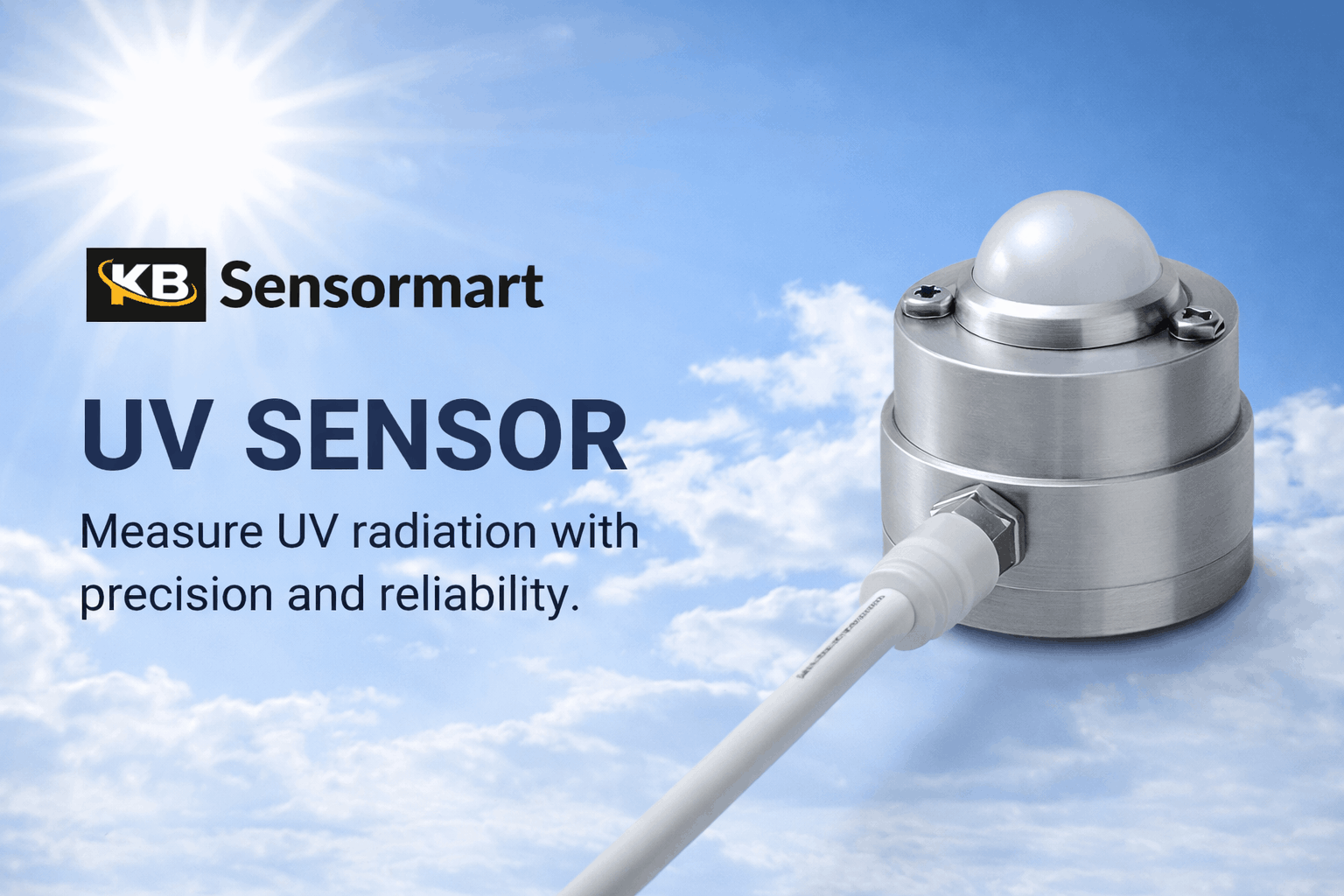
An ultraviolet radiation detector, commonly known as a UV Sensor, plays a vital role in measuring electromagnetic radiation emitted by the sun or artificial light sources. At Sensormart, we engineer high-precision optical monitoring equipment designed for industrial automation, weather tracking, and environmental research.
Understanding ultraviolet radiation is crucial for human health, agricultural productivity, industrial curing, and water disinfection. This comprehensive guide explores how a UV Sensor works, its primary classifications, industrial applications, maintenance procedures, and key selection criteria.more blogs
Understanding the Fundamentals of a UV Sensor
A UV Sensor is a specialized optoelectronic instrument engineered to detect electromagnetic radiation within the ultraviolet spectrum, spanning wavelengths from 100 nm to 400 nm. While human eyes can only perceive visible light between 400 nm and 700 nm, ultraviolet radiation carries higher photon energy capable of driving chemical reactions, degrading materials, or neutralizing harmful pathogens.
By installing a UV Sensor, engineers and researchers can convert invisible optical energy into a precise electrical signal. This allows monitoring systems to record real-time radiation intensity in units of milliwatts per square centimeter ($\text{mW/cm}^2$) or watts per square meter ($\text{W/m}^2$). Advanced optical devices supplied by Sensormart feature selective filtering to isolate specific ultraviolet bands, preventing interference from visible sunlight or infrared heat.
How Does a UV Sensor Work?
The operational core of a digital UV Sensor relies on the photoelectric effect and semiconductor photoconductivity. Inside the sensor, a specialized optical element reacts when struck by ultraviolet photons.
- Photon Absorption: As light passes through a protective quartz or glass diffuser, ultraviolet photons enter the semiconductor material (such as silicon, gallium nitride, or silicon carbide).
- Charge Carrier Generation: Photons with energy greater than the semiconductor bandgap release free electrons, generating electron-hole pairs.
- Current Amplification: A micro-ampere electrical current flows across the sensor junction proportional to the incoming ultraviolet intensity.
- Signal Processing & Output: Internal microcircuitry converts the raw analog signal into a calibrated digital reading.
Modern units engineered by Sensormart incorporate cosine correction optics and ultra-violet optical filters. Cosine correction ensures the UV Sensor accurately collects directional sunlight regardless of the sun’s angle in the sky, delivering reliable data from dawn to dusk.
Classifications of Ultraviolet Light Detected by a UV Sensor
Ultraviolet light is divided into three distinct bands based on wavelength and photon energy. A high-quality UV Sensor can be customized to monitor individual wavebands or broad-spectrum UV radiation.
| UV Sensor Category | Wavelength Range | Natural & Artificial Sources | Key Primary Applications |
| UV-A Sensor | $315\text{ nm} – 400\text{ nm}$ | Sunlight, black lights, tanning lamps | Agricultural growth tracking, UV curing, insect traps |
| UV-B Sensor | $280\text{ nm} – 315\text{ nm}$ | Sunlight, specialized medical LEDs | Erythema prevention, materials degradation, weather research |
| UV-C Sensor | $100\text{ nm} – 280\text{ nm}$ | Low-pressure mercury lamps, UVC LEDs | Germicidal disinfection, water purification, air sanitation |
| Broadband UV Sensor | $280\text{ nm} – 400\text{ nm}$ | Outdoor natural solar radiation | Meteorological stations, solar exposure, UV Index reporting |
Choosing a UV Sensor tailored to your required spectral range ensures maximum measurement accuracy without cross-sensitivity from unwanted light spectrums.
Key Applications of a UV Sensor Across Industries
Because ultraviolet energy is widely used in both natural ecosystems and industrial manufacturing, a UV Sensor serves as an indispensable control component across several sectors:
1. Water Disinfection and Air Purification Systems
Short-wave UVC radiation ($254\text{ nm}$) destroys the DNA and RNA of viruses, bacteria, and micro-organisms. Water treatment plants place an inline UV Sensor inside reactor chambers to continuously measure lamp output. If quartz sleeves become fouled or UVC lamps degrade over time, the UV Sensor immediately alerts operators to prevent under-treated water from entering supply lines.
2. Smart Agriculture and Greenhouse Management
Plant photosynthesis and secondary metabolite production (such as flavonoids and antioxidants) are strongly influenced by UV radiation. Farmers mount an outdoor UV Sensor from Sensormart inside commercial greenhouses to optimize supplemental lighting, evaluate shade cloth performance, and prevent crop foliage scorching.
3. Industrial Coating, Printing, and UV Curing
In modern manufacturing, ultraviolet lamps are used to instantly cure adhesives, protective coatings, inks, and electronic encapsulants. An industrial UV Sensor measures light intensity along conveyor belts to ensure consistent polymerization, preventing under-cured or sticky surface finishes.
4. Weather Forecasting and Environmental Stations
Meteorological stations deploy an outdoor-rated UV Sensor to calculate the daily UV Index. This continuous data helps public health agencies broadcast sun exposure warnings to protect communities against sunburns and skin damage.
5. High-Voltage Electrical Discharge Detection
Electrical arcing and partial discharges in transformer yards or high-voltage lines emit subtle flashes of short-wave ultraviolet radiation. A specialized corona UV Sensor can detect solar-blind UV emissions in broad daylight, allowing power grid operators to locate insulation failures before catastrophic blackouts occur.
Essential Features to Consider When Selecting a UV Sensor
When choosing a UV Sensor for your facility or project, evaluate the following technical parameters:
- Spectral Responsivity: Ensure the internal photodetector is filtered strictly for your target waveband (UVA, UVB, or UVC).
- Signal Output Interface: Industrial monitoring systems prefer a UV Sensor equipped with standard analog outputs ($4-20\text{ mA}$ or $0-5\text{ V}$) or digital communication interfaces like RS485 Modbus RTU for long-distance wiring.
- Enclosure Protection Class: For outdoor weather stations or humid water treatment units, select an IP67 or IP68 waterproof UV Sensor housing constructed from stainless steel or anodized aluminum.
- Operating Temperature Compensation: Ambient heat can alter photodiode output. A high-grade UV Sensor from Sensormart includes integrated thermal compensation to ensure steady readings from $-40^\circ\text{C}$ to $80^\circ\text{C}$.
- Response Speed: Look for a fast response time ($\le 1\text{ second}$) to capture rapid light fluctuations or high-speed curing processes.
Step-by-Step Installation and Maintenance Guidelines
Proper mounting and routine maintenance ensure your UV Sensor maintains long-term calibration accuracy:
- Unobstructed Positioning: Mount the UV Sensor horizontally in an open area free from shadows cast by nearby walls, trees, or structural frames.
- Proper Alignment: Use the built-in leveling bubble to ensure the cosine collector is perfectly flat when recording solar radiation.
- Secure Wiring: Connect power and signal cables ($9-30\text{ V DC}$) securely to prevent voltage drops or ground loops.
- Regular Lens Cleaning: Dust, grease, or water spots on the glass window reduce light transmittance. Gently wipe the UV Sensor lens using isopropyl alcohol and a microfiber cloth once a month.
- Periodic Recalibration: Optical sensors experience slight drift over years of intense light exposure. Re-calibrate your UV Sensor annually using certified laboratory standards from Sensormart. wikipedia
Frequently Asked Questions (FAQs)
1. What is the primary purpose of a UV Sensor?
A UV Sensor measures the intensity of ultraviolet light emitted by solar radiation or artificial UV lamps, converting photon energy into a readable electrical output for safety, industrial process control, and research.
2. Can a UV Sensor measure UVC disinfection lamps?
Yes, a specialized UVC UV Sensor is tuned specifically to detect short wavelengths ($200\text{ nm} – 280\text{ nm}$) used in germicidal lamps. It ensures water and air purification systems maintain sufficient energy levels to neutralize pathogens.
3. How does a Sensormart UV Sensor communicate with PLCs or data loggers?
A Sensormart UV Sensor supports standard industrial outputs, including 4-20mA analog signals, 0-5V voltage outputs, and digital RS485 Modbus communications, making integration into existing SCADA or automation systems seamless.
4. What is the difference between a solar pyranometer and a UV Sensor?
A solar pyranometer measures total solar irradiance across broad solar spectrums ($300\text{ nm} – 3000\text{ nm}$), whereas a UV Sensor utilizes optical filters to isolate and measure only ultraviolet radiation ($100\text{ nm} – 400\text{ nm}$).
5. Why is cosine correction important for an outdoor UV Sensor?
Cosine correction ensures that an outdoor UV Sensor captures incoming light accurately relative to the sun’s angle. Without cosine correction, oblique morning or late afternoon sunlight would produce lower readings than actual exposure levels.
6. How long does an industrial UV Sensor typically last?
A high-grade UV Sensor featuring rugged IP67 weatherproofing, quartz glass optics, and corrosion-resistant housing can operate reliably for 5 to 10 years when properly cleaned and calibrated.
Selecting reliable optical monitoring equipment is vital for maintaining product quality, environmental safety, and operational efficiency. A precision UV Sensor supplied by Sensormart delivers the durability, accuracy, and output flexibility required for challenging industrial and field environments. Explore our complete lineup of advanced environmental instruments at Sensormart to find the ideal sensing solution for your operational needs.




Leave a Reply